Page 1 of 2
Download
Get this sheet
SubscriptionOpen any sheet in any course, up to 40 a month, keys included. Or $40 month to month.
$25/mo, billed yearly
SubscribeTry one first: a free Chapter 1 worksheet (PDF, no sign-in).
What's on the worksheet
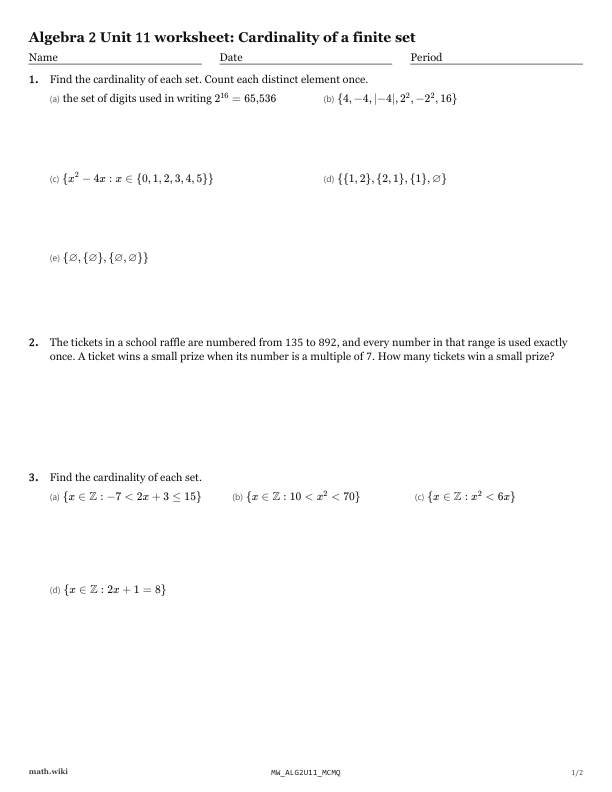
- Find the cardinality of each set, counting each distinct element once.the set of digits used in writing 2^{16} = 65{,}536\{4, -4, \lvert -4\rvert, 2^2, -2^2, 16\}\{x^2 - 4x : x \in \{0, 1, 2, 3, 4, 5\}\}\{\{1, 2\}, \{2, 1\}, \{1\}, \varnothing\}\{\varnothing, \{\varnothing\}, \{\varnothing, \varnothing\}\}
- Word problem: raffle tickets numbered 135 to 892 that win a prize.
- Find the cardinality of each set of integers defined by an inequality.\{x \in \mathbb{Z} : -7 < 2x + 3 \le 15\}\{x \in \mathbb{Z} : 10 < x^2 < 70\}\{x \in \mathbb{Z} : x^2 < 6x\}\{x \in \mathbb{Z} : 2x + 1 = 8\}
- Give a one-to-one match for each set and state its cardinality.
- Find the sizes of two sets and explain how they compare.
- Count four-digit palindromes and compare with another set.
Teach it first
The free lesson teaches it with worked examples and practice problems.
Cardinality of a finite set: the lesson ›More Chapter 11 worksheets: Counting
- 11.1Cardinality of a finite set
- 11.2Venn diagrams and counting a union
- 11.3Arrangements and factorials
- 11.4Permutations
- 11.5Combinations
- 11.6Counting with restrictions
- 11.7Pascal's triangle
- 11.8The binomial theorem