Page 1 of 2
Download
Get this sheet
SubscriptionOpen any sheet in any course, up to 40 a month, keys included. Or $40 month to month.
$25/mo, billed yearly
SubscribeTry one first: a free Chapter 1 worksheet (PDF, no sign-in).
What's on the worksheet
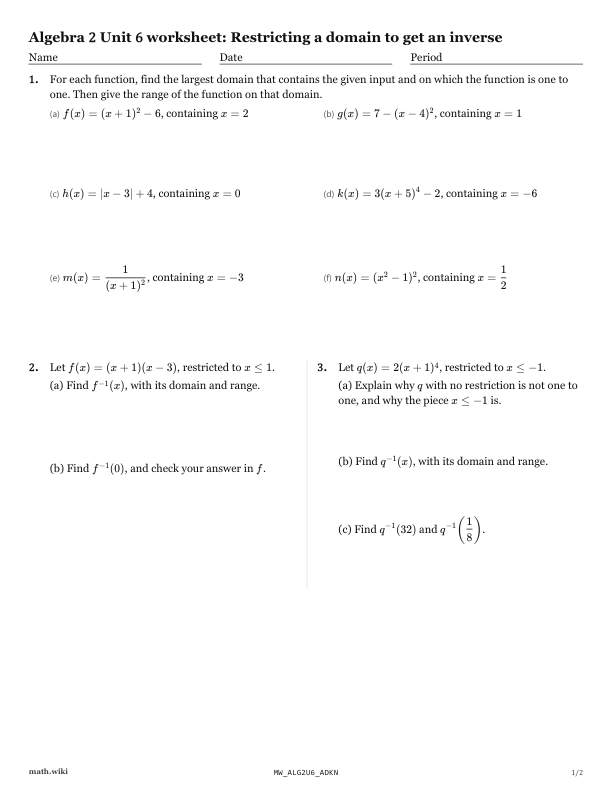
- Find the largest one-to-one domain containing the given input and the range on it.f(x) = (x + 1)^2 - 6, containing x = 2g(x) = 7 - (x - 4)^2, containing x = 1h(x) = \lvert x - 3 \rvert + 4, containing x = 0k(x) = 3(x + 5)^4 - 2, containing x = -6m(x) = \dfrac{1}{(x + 1)^2}, containing x = -3
- Find the inverse of a quadratic restricted to x at most 1, with domain and range.
- Explain why the fourth-power function needs a restriction and find its inverse.
- Test Jenny's inverse for a restricted quadratic with an output and find her error.
- Word problem: the height of a parabolic road tunnel entrance and its inverse.
- Find the one-to-one piece of an absolute value function around x equal to 2 and its inverse.
Teach it first
The free lesson teaches it with worked examples and practice problems.
Restricting a domain to get an inverse: the lesson ›More Chapter 6 worksheets: Combined, composite and inverse functions
- 6.1Adding, subtracting and multiplying functions
- 6.2Dividing functions and the domain of a combination
- 6.3Evaluating a composition from numbers, tables and graphs
- 6.4Composing functions algebraically
- 6.5Domain of a composition
- 6.6One to one functions and the horizontal line test
- 6.7Inverse from a table or list of pairs
- 6.8Finding an inverse from a rule
- 6.9The graph of an inverse
- 6.10Restricting a domain to get an inverse