Page 1 of 2
Download
Get this sheet
SubscriptionOpen any sheet in any course, up to 40 a month, keys included. Or $40 month to month.
$25/mo, billed yearly
SubscribeTry one first: a free Chapter 1 worksheet (PDF, no sign-in).
What's on the worksheet
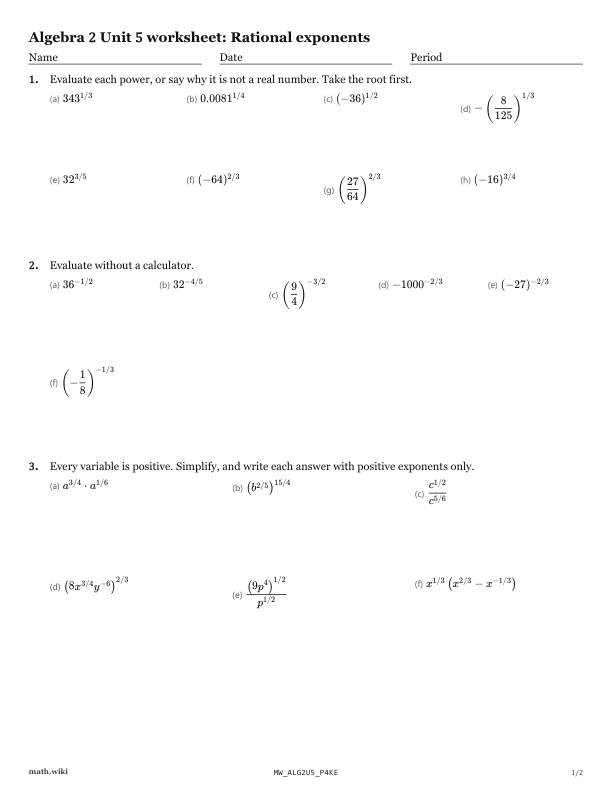
- Evaluate each power, or say why it is not a real number:343^{1/3}0.0081^{1/4}(-36)^{1/2}-\left(\dfrac{8}{125}\right)^{1/3}32^{3/5}
- Evaluate without a calculator:36^{-1/2}32^{-4/5}\left(\dfrac{9}{4}\right)^{-3/2}-1000^{-2/3}(-27)^{-2/3}
- Simplify, writing each answer with positive exponents only:a^{3/4} \cdot a^{1/6}\left(b^{2/5}\right)^{15/4}\dfrac{c^{1/2}}{c^{5/6}}\left(8x^{3/4}y^{-6}\right)^{2/3}\dfrac{\left(9p^4\right)^{1/2}}{p^{1/2}}
- Rewrite with rational exponents and write each answer as a single radical.\sqrt[3]{x^2} \cdot \sqrt[4]{x}\dfrac{\sqrt{x}}{\sqrt[3]{x}}\sqrt[3]{x\sqrt{x}}\dfrac{\sqrt[3]{4}}{\sqrt[6]{2}}
- Solve each equation over the real numbers and check every answer:x^{1/4} = 3x^{2/5} = 4x^{-2/3} = \dfrac{1}{9}3x^{3/4} = 24x^{3/2} = -8
- Word problem: the surface area of an ice cube from its volume.
Teach it first
The free lesson teaches it with worked examples and practice problems.
Rational exponents: the lesson ›