Page 1 of 2
Download
Get this sheet
SubscriptionOpen any sheet in any course, up to 40 a month, keys included. Or $40 month to month.
$25/mo, billed yearly
SubscribeTry one first: a free Chapter 1 worksheet (PDF, no sign-in).
What's on the worksheet
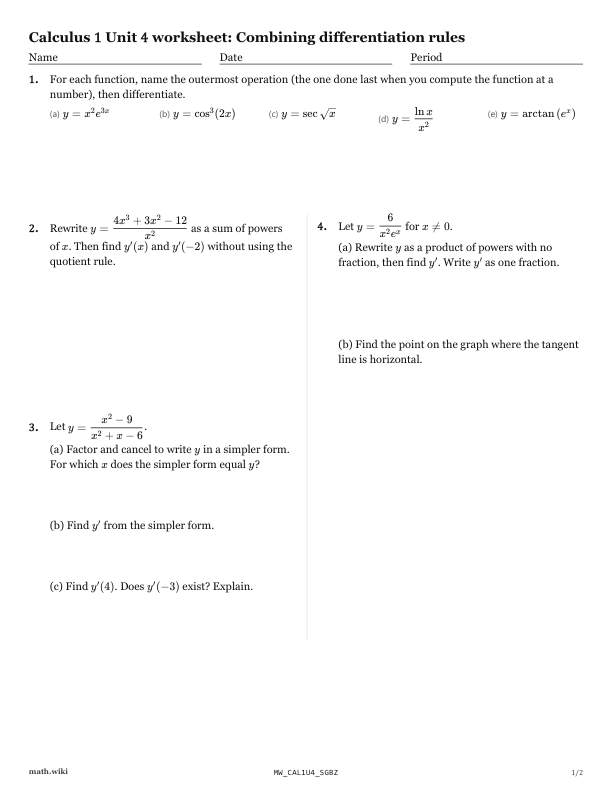
- For each function, name the outermost operation (the one done last when you compute the function at a number), then differentiate.y = x^2 e^{3x}y = \cos^3(2x)y = \sec\sqrt{x}y = \dfrac{\ln x}{x^2}y = \arctan\left(e^{x}\right)
- Rewrite y = 4x³ + 3x² - 12x² as a sum of powers of x.
- Let y = x² - 9x² + x - 6.
- Let y = 6x² e^x for x ≠ 0.
- The functions f and g are differentiable, with these values.
- 1 2 3 4 5 6 7 1 2 3 4 5 0 x y y = f
Teach it first
The free lesson teaches it with worked examples and practice problems.
Combining differentiation rules: the lesson ›More Chapter 4 worksheets: Chain rule, implicit differentiation and inverse functions
- 4.1The chain rule
- 4.2Implicit differentiation
- 4.3Derivatives of logarithms and logarithmic differentiation
- 4.4Derivatives of inverse functions
- 4.5Derivatives of inverse trigonometric functions
- 4.6Combining differentiation rules