Page 1 of 2
Download, free
The full Calculus 1 courseEvery lesson in teaching order, with over 300 printables.See the course ›What's on the worksheet
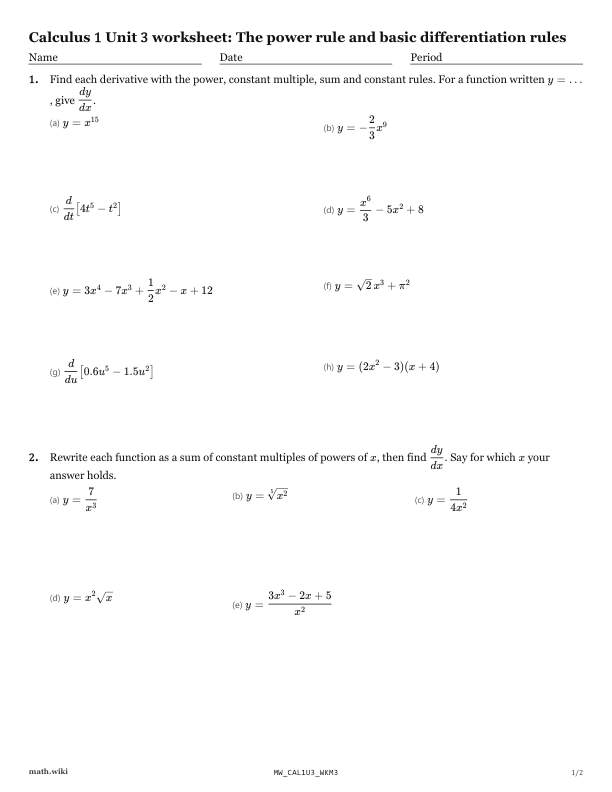
- Find each derivative with the power, constant multiple, sum and constant rules.y = x^{15}y = -\dfrac{2}{3}x^{9}\dfrac{d}{dt}\big[4t^5 - t^2\big]y = \dfrac{x^6}{3} - 5x^2 + 8y = 3x^4 - 7x^3 + \dfrac{1}{2}x^2 - x + 12
- Rewrite each function as a sum of constant multiples of powers of x, then find dydx.y = \dfrac{7}{x^3}y = \sqrt[5]{x^2}y = \dfrac{1}{4x^2}y = x^2\sqrt{x}y = \dfrac{3x^3 - 2x + 5}{x^2}
- The curve y = ax³ + bx², where a and b are constants, has slope −17 at x = 1 and slope −52 at x = 2.
- Lucas rewrites each function as a power of x and then uses the power rule, but each line has one mistake.
- Let $f
Teach it first
The free lesson teaches it with worked examples and practice problems.
The power rule and basic differentiation rules: the lesson ›More Chapter 3 worksheets: Differentiation rules
- 3.1The power rule and basic differentiation rules
- 3.2The derivative as a rate of change
- 3.3Tangent lines and normal lines
- 3.4Derivatives of exponential functions
- 3.5The product rule
- 3.6The quotient rule
- 3.7Derivatives of the trigonometric functions
- 3.8Second and higher derivatives