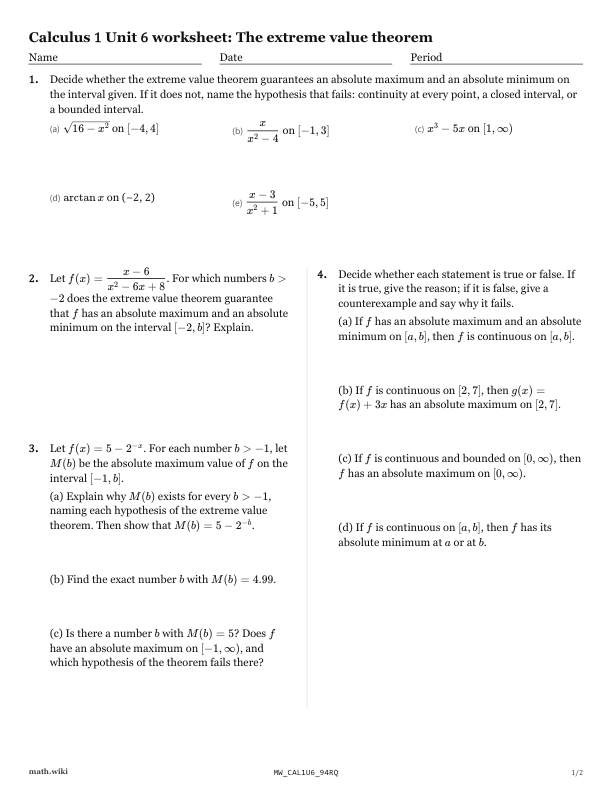
Page 1 of 2
Download
Get this sheet
SubscriptionOpen any sheet in any course, up to 40 a month, keys included. Or $40 month to month.
$25/mo, billed yearly
SubscribeTry one first: a free Chapter 1 worksheet (PDF, no sign-in).
What's on the worksheet
- Decide whether the extreme value theorem guarantees an absolute maximum and an absolute minimum on the interval given.\sqrt{16 - x^2} on [-4, 4]\dfrac{x}{x^2 - 4} on [-1, 3]x^3 - 5x on [1, \infty)\arctan x on (−2, 2)\dfrac{x - 3}{x^2 + 1} on [-5, 5]
- Let $f
- Let $f
- Decide whether each statement is true or false.
- −2 −1 1 2 3 4 1 2 4 x y y = f
- A hydrology class pours a pulse of harmless dye into a stream and measures it at a bridge downstream.
Teach it first
The free lesson teaches it with worked examples and practice problems.
The extreme value theorem: the lesson ›More Chapter 6 worksheets: Analyzing functions: extrema, the mean value theorem, curve sketching, optimization
- 6.1The mean value theorem
- 6.2The extreme value theorem
- 6.3Critical points and local versus absolute extrema
- 6.4Increasing and decreasing from the derivative
- 6.5Position, velocity and acceleration
- 6.6Extrema on a closed interval
- 6.7Concavity and inflection points
- 6.8The first and second derivative tests
- 6.9Curve sketching and connecting f, f' and f''
- 6.10Optimization