Page 1 of 4
Download
Get this sheet
SubscriptionOpen any sheet in any course, up to 40 a month, keys included. Or $40 month to month.
$25/mo, billed yearly
SubscribeTry one first: a free Chapter 1 worksheet (PDF, no sign-in).
What's on the worksheet
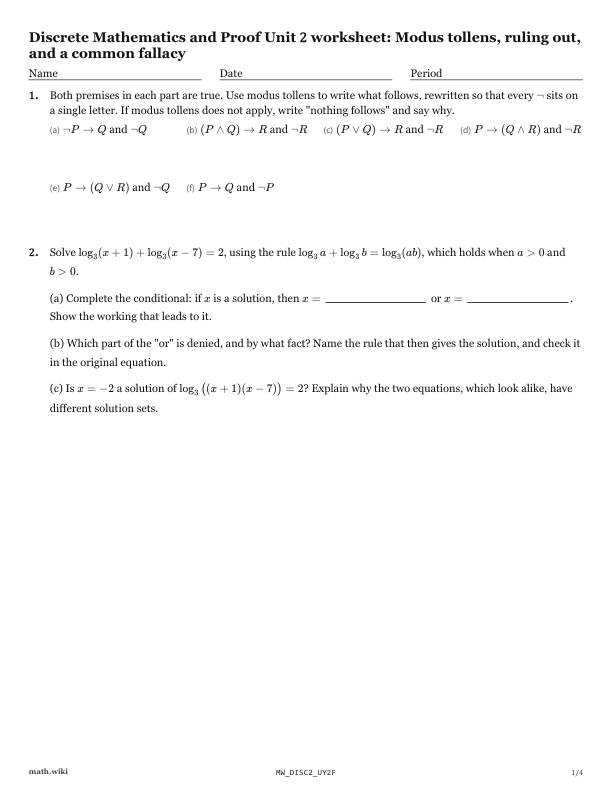
- Both premises in each part are true.\neg P \to Q and \neg Q(P \land Q) \to R and \neg R(P \lor Q) \to R and \neg RP \to (Q \land R) and \neg RP \to (Q \lor R) and \neg Q
- Solve _3(x + 1) + _3(x - 7) = 2, using the rule _3 a + _3 b = _3(ab), which holds when a > 0 and b > 0.
- A lab sample is known to be one of four metals:
- A theorem:
- A 10-digit ISBN d_1 d_2 d_3 d_10 passes the check when 10d_1 + 9d_2 + 8d_3 + 7d_4 + 6d_5 + 5d_6 + 4d_7 + 3d_8 + 2d_9 + d_{10} is a multiple of 11.
- Let n be an integer.
Teach it first
The free lesson teaches it with worked examples and practice problems.
Modus tollens, ruling out, and a common fallacy: the lesson ›More Chapter 2 worksheets: Quantifiers and valid arguments
- 2.1For all
- 2.2There exists, and there is exactly one
- 2.3Negating a quantified statement
- 2.4Nested quantifiers
- 2.5Valid and sound arguments
- 2.6Modus ponens, chaining, and a common fallacy
- 2.7Modus tollens, ruling out, and a common fallacy
- 2.8Testing an argument with a truth table