Page 1 of 2
Download
Get this sheet
SubscriptionOpen any sheet in any course, up to 40 a month, keys included. Or $40 month to month.
$25/mo, billed yearly
SubscribeTry one first: a free Chapter 1 worksheet (PDF, no sign-in).
What's on the worksheet
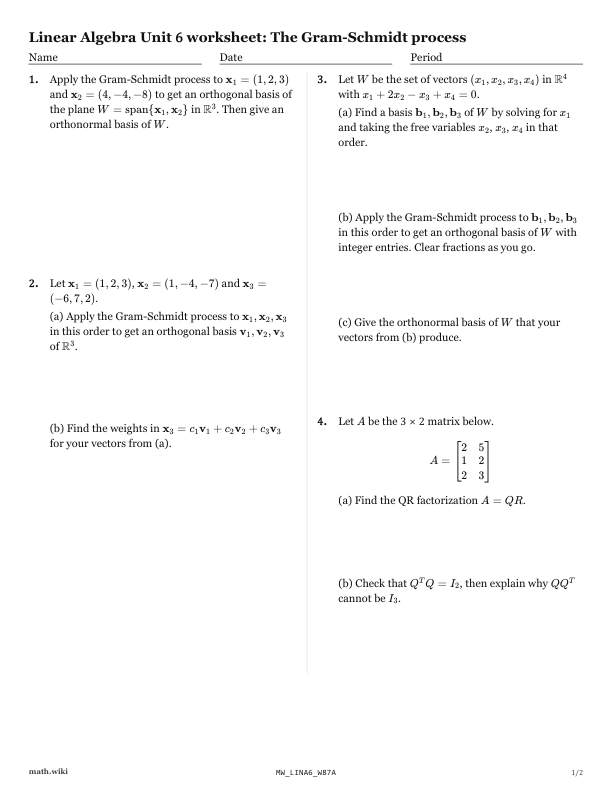
- Apply the Gram-Schmidt process to x_1 = (1, 2, 3) and x_2 = (4, -4, -8) to get an orthogonal basis of the plane W = span\x_1, x_2\ in R³.
- Let x_1 = (1, 2, 3), x_2 = (1, -4, -7) and x_3 = (-6, 7, 2).
- Let W be the set of vectors (x_1, x_2, x_3, x_4) in R^4 with x_1 + 2x_2 - x_3 + x_4 = 0.
- Let A be the 3 × 2 matrix below.
- Let x_1 = (1, 0, 1, 1), x_2 = (2, 1, 1, 0), x_3 = (5, 2, 3, 1), x_4 = (1, 2, 1, 0) and W = span\x_1, x_2, x_3, x_4\ in R^4.
- Let x_1, x_2, x_3 be independent vectors in R^n, let c, d, e be any numbers, and let \mathbf{y}_1 = \mathbf{x}_1, \quad \mathbf{y}_2 = \mathbf{x}_2…
Teach it first
The free lesson teaches it with worked examples and practice problems.
The Gram-Schmidt process: the lesson ›More Chapter 6 worksheets: Orthogonality and least squares
- 6.1Orthogonal bases and projection onto a subspace
- 6.2The Gram-Schmidt process
- 6.3Least squares: the best approximate solution of Ax = b