Page 1 of 3
Download
Get this sheet
SubscriptionOpen any sheet in any course, up to 40 a month, keys included. Or $40 month to month.
$25/mo, billed yearly
SubscribeTry one first: a free Chapter 1 worksheet (PDF, no sign-in).
What's on the worksheet
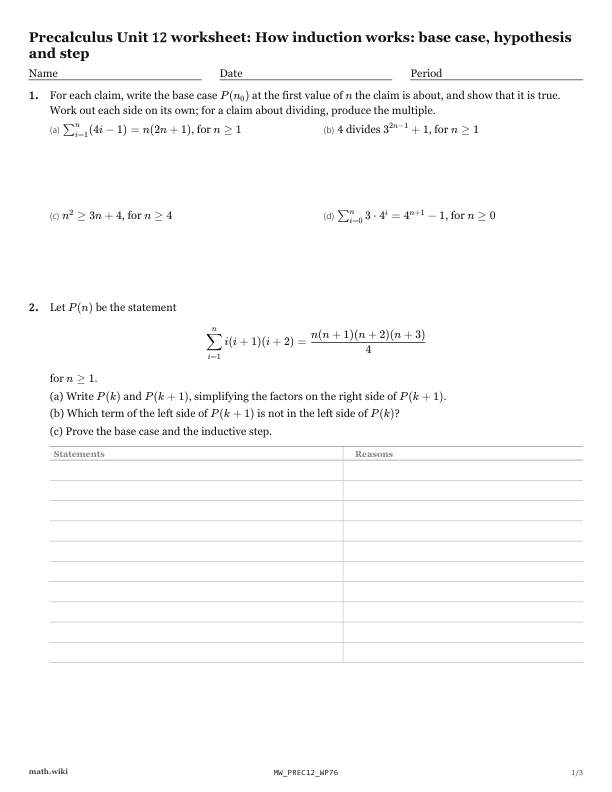
- For each claim, write the base case P(n_0) at the first value of n the claim is about, and show that it is true.\sum_{i=1}^{n} (4i - 1) = n(2n + 1), for n \ge 14 divides 3^{2n-1} + 1, for n \ge 1n^2 \ge 3n + 4, for n \ge 4\sum_{i=0}^{n} 3 \cdot 4^i = 4^{n+1} - 1, for n \ge 0
- Let $P
- A sequence is defined by a_1 = 1 and a_n+1 = a_n1 + a_n for n ≥ 1.
- Consider the claim 2^n > 2n + 1.
- A classmate wants to prove _i=1^n 12^i = 1 - 12^n for every n ≥ 1 and writes this as the whole proof.
Teach it first
The free lesson teaches it with worked examples and practice problems.
How induction works: base case, hypothesis and step: the lesson ›More Chapter 12 worksheets: Induction, sequences and an introduction to limits
- 12.1Sigma notation
- 12.2Arithmetic series and partial sums
- 12.3Geometric series
- 12.4Infinite geometric series
- 12.5How induction works: base case, hypothesis and step
- 12.6What a limit is: graphs and tables