Page 1 of 3
Download
Get this sheet
SubscriptionOpen any sheet in any course, up to 40 a month, keys included. Or $40 month to month.
$25/mo, billed yearly
SubscribeTry one first: a free Chapter 1 worksheet (PDF, no sign-in).
What's on the worksheet
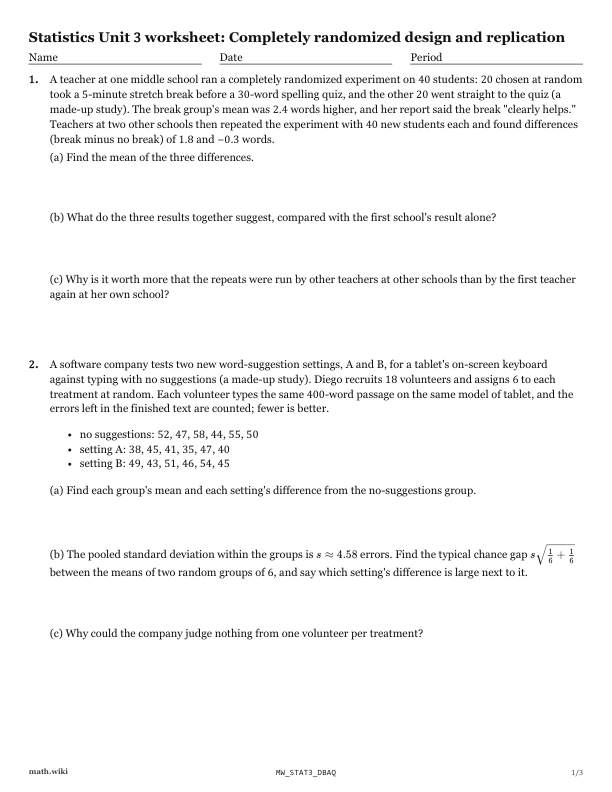
- A teacher at one middle school ran a completely randomized experiment on 40 students:
- A software company tests two new word-suggestion settings, A and B, for a tablet's on-screen keyboard against typing with no suggestions (a made-up…
- In a completely randomized design each unit must be able to receive any of the treatments, and no unit's treatment may spill onto another unit.
- A woodworking club wants to compare two new wood glues, X and Y, with the white glue its members use now (a made-up study).
- A food lab tests whether drying temperature changes the moisture left in dried apple slices (a made-up study).
- Layla wants to know whether an avocado ripens sooner in a paper bag with a banana than in a paper bag alone or on the open counter (a made-up study).
Teach it first
The free lesson teaches it with worked examples and practice problems.
Completely randomized design and replication: the lesson ›More Chapter 3 worksheets: Collecting data: sampling and experiments
- 3.1Observational studies and experiments
- 3.2Stratified random sample
- 3.3Systematic sample
- 3.4Cluster samples and choosing a design
- 3.5Undercoverage and nonresponse
- 3.6Units, treatments, factors and levels
- 3.7Control groups, placebos and blinding
- 3.8Random assignment and confounding
- 3.9Completely randomized design and replication
- 3.10Blocking: randomized block and matched pairs designs