Page 1 of 3
Download
Get this sheet
SubscriptionOpen any sheet in any course, up to 40 a month, keys included. Or $40 month to month.
$25/mo, billed yearly
SubscribeTry one first: a free Chapter 1 worksheet (PDF, no sign-in).
What's on the worksheet
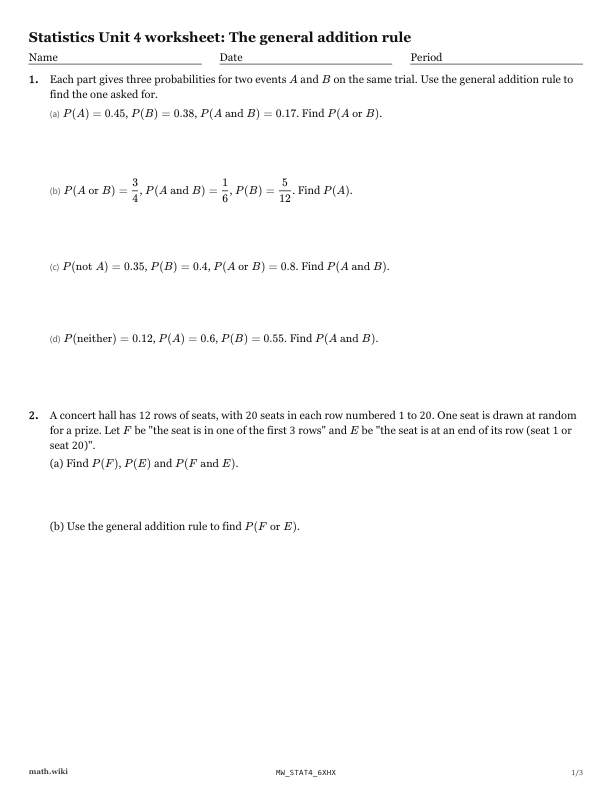
- Each part gives three probabilities for two events A and B on the same trial.
- A concert hall has 12 rows of seats, with 20 seats in each row numbered 1 to 20.
- \text{coffee} \text{pastry} 0.34 0.21 0.17 \text{neither:
- At a Saturday farmers' market, 44% of shoppers buy fruit, 48% buy bread, and 72% buy exactly one of the two.
- A local radio station knows that 60% of its listeners tune in to the morning show and 55% tune in to the evening show.
- An ice rink sold 140 tickets on Saturday, each for the afternoon session or the evening session.
Teach it first
The free lesson teaches it with worked examples and practice problems.
The general addition rule: the lesson ›More Chapter 4 worksheets: Probability and random variables
- 4.1The general addition rule
- 4.2Finding a conditional probability
- 4.3The general multiplication rule
- 4.4Running a simulation and estimating a probability
- 4.5Density curves: area, mean and median
- 4.6The standard normal distribution
- 4.7Normal calculations: areas and percentiles
- 4.8Random variables and probability distributions
- 4.9Cumulative probability
- 4.10Expected value
- 4.11Variance and standard deviation of a random variable
- 4.12Linear transformations of a random variable
- 4.13Combining random variables