Page 1 of 2
Download
Get this sheet
SubscriptionOpen any sheet in any course, up to 40 a month, keys included. Or $40 month to month.
$25/mo, billed yearly
SubscribeTry one first: a free Chapter 1 worksheet (PDF, no sign-in).
What's on the worksheet
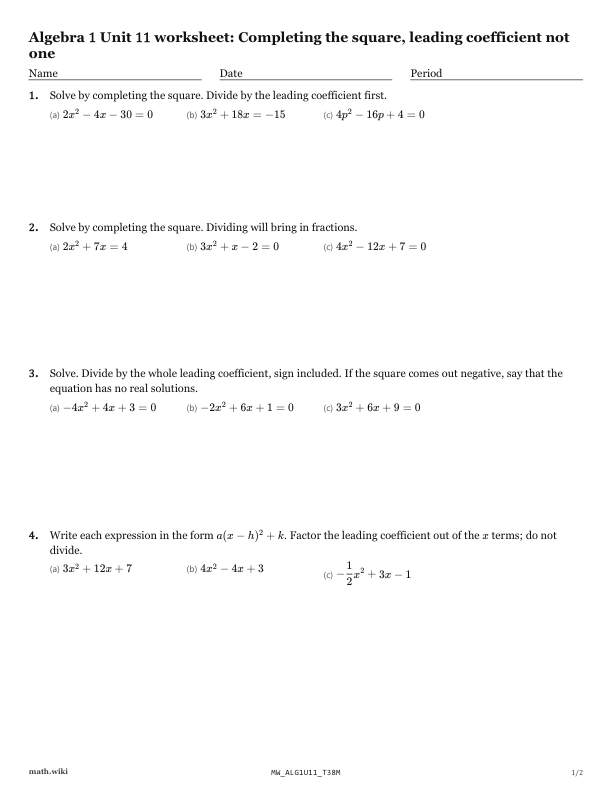
- Solve by completing the square, dividing by the leading coefficient first.2x^2 - 4x - 30 = 03x^2 + 18x = -154p^2 - 16p + 4 = 0
- Solve by completing the square where dividing brings in fractions.2x^2 + 7x = 43x^2 + x - 2 = 04x^2 - 12x + 7 = 0
- Solve by dividing by the whole leading coefficient, and say if there are no real solutions.-4x^2 + 4x + 3 = 0-2x^2 + 6x + 1 = 03x^2 + 6x + 9 = 0
- Write each expression in the form with a squared bracket by factoring out the leading coefficient.3x^2 + 12x + 74x^2 - 4x + 3-\dfrac{1}{2}x^2 + 3x - 1
- Dam water depth: use the monthly model to answer questions.
- Check a student's vertex form by substituting a value and find the error.
- Find b and c from the step of completing the square, then solve.
Teach it first
The free lesson teaches it with worked examples and practice problems.
Completing the square, leading coefficient not one: the lesson ›More Chapter 11 worksheets: Solving quadratic equations
- 11.1Solving quadratics by factoring
- 11.2Solving quadratics with square roots
- 11.3Completing the square
- 11.4Completing the square, leading coefficient not one
- 11.5Vertex form: reading, converting and graphing
- 11.6Factored form
- 11.7Reading a quadratic in its three forms
- 11.8Deriving the quadratic formula
- 11.9Using the quadratic formula
- 11.10The discriminant and the number of real solutions
- 11.11Maximum, minimum and projectile problems
- 11.12Systems with a curve