Page 1 of 2
Download
Get this sheet
SubscriptionOpen any sheet in any course, up to 40 a month, keys included. Or $40 month to month.
$25/mo, billed yearly
SubscribeTry one first: a free Chapter 1 worksheet (PDF, no sign-in).
What's on the worksheet
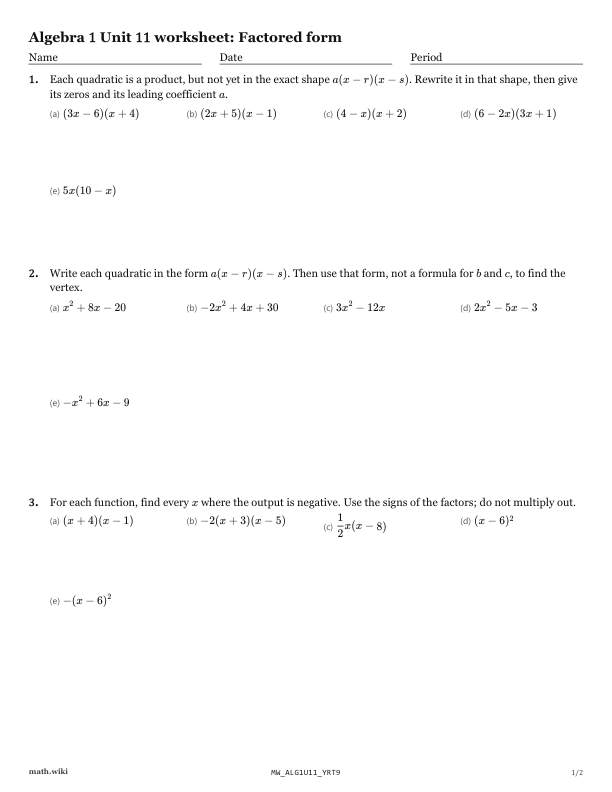
- Rewrite each quadratic in factored shape, then give its zeros and leading coefficient.(3x - 6)(x + 4)(2x + 5)(x - 1)(4 - x)(x + 2)(6 - 2x)(3x + 1)5x(10 - x)
- Write each quadratic in factored form and use it to find the vertex.x^2 + 8x - 20-2x^2 + 4x + 303x^2 - 12x2x^2 - 5x - 3-x^2 + 6x - 9
- Find every x where the output is negative using the signs of the factors.(x + 4)(x - 1)-2(x + 3)(x - 5)\dfrac{1}{2}x(x - 8)(x - 6)^2-(x - 6)^2
- Wind-up toy frog: use the height rule to find where it lands and its top height.
- Check Hannah's reading of the zeros and opening direction of a factored function.
- Write a quadratic in factored form with radical zeros and give its axis of symmetry.
- Find p so that the vertex has a given x-coordinate, then find the vertex.
- Compare two parabolas with the same zeros: name shared points and see how they differ.
- Find the other zero and the equation from a y-intercept, an axis and one zero.
Teach it first
The free lesson teaches it with worked examples and practice problems.
Factored form: the lesson ›More Chapter 11 worksheets: Solving quadratic equations
- 11.1Solving quadratics by factoring
- 11.2Solving quadratics with square roots
- 11.3Completing the square
- 11.4Completing the square, leading coefficient not one
- 11.5Vertex form: reading, converting and graphing
- 11.6Factored form
- 11.7Reading a quadratic in its three forms
- 11.8Deriving the quadratic formula
- 11.9Using the quadratic formula
- 11.10The discriminant and the number of real solutions
- 11.11Maximum, minimum and projectile problems
- 11.12Systems with a curve