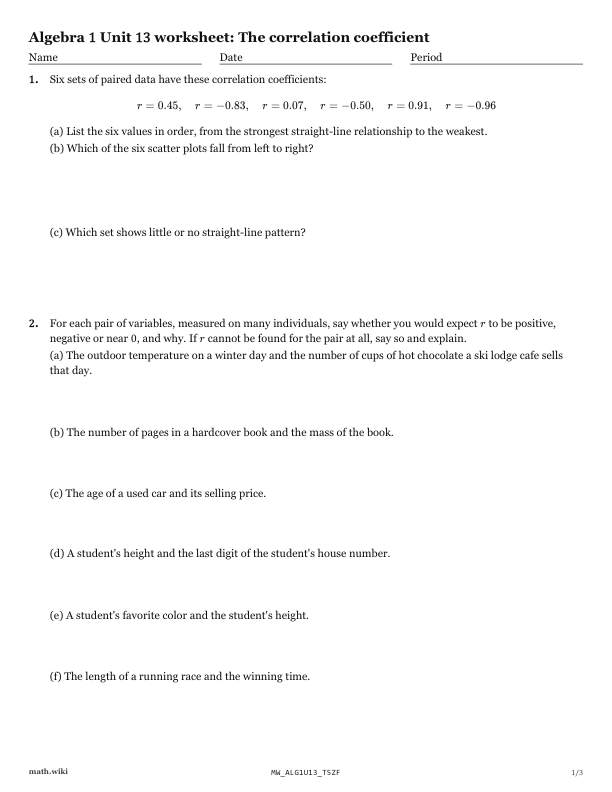
Page 1 of 3
Download
Get this sheet
SubscriptionOpen any sheet in any course, up to 40 a month, keys included. Or $40 month to month.
$25/mo, billed yearly
SubscribeTry one first: a free Chapter 1 worksheet (PDF, no sign-in).
What's on the worksheet
- Match six values of r to descriptions of paired data.
- Say whether r should be positive, negative or near 0 for each pair of variables, and why.
- Decide for each data set whether r is 1, negative 1, cannot be found or something else.(1, 7), (2, 5), (3, 3), (4, 1)(2, 4), (2, 6), (2, 9)(0, 3), (5, 13), (10, 23)(1, 2), (2, 4), (3, 8), (4, 16)(−2, 5), (0, 5), (3, 5)
- Library hours and books borrowed: find and interpret r for five weekdays.
- Two weather stations: compare sunshine hours and the highest temperature.
- Public charging points by year: find r and decide how to read it.
Teach it first
The free lesson teaches it with worked examples and practice problems.
The correlation coefficient: the lesson ›More Chapter 13 worksheets: Two-variable statistics
- 13.1Fitting linear and exponential models with technology
- 13.2Predicting with a regression line, and extrapolation
- 13.3Interpreting a residual
- 13.4Making and reading residual plots
- 13.5The correlation coefficient
- 13.6Properties of the correlation coefficient
- 13.7Observational studies and experiments
- 13.8Correlation is not causation: lurking and confounding variables
- 13.9Describing a scatter plot
- 13.10Line of best fit
- 13.11Conditional relative frequencies