Page 1 of 2
Download
Get this sheet
SubscriptionOpen any sheet in any course, up to 40 a month, keys included. Or $40 month to month.
$25/mo, billed yearly
SubscribeTry one first: a free Chapter 1 worksheet (PDF, no sign-in).
What's on the worksheet
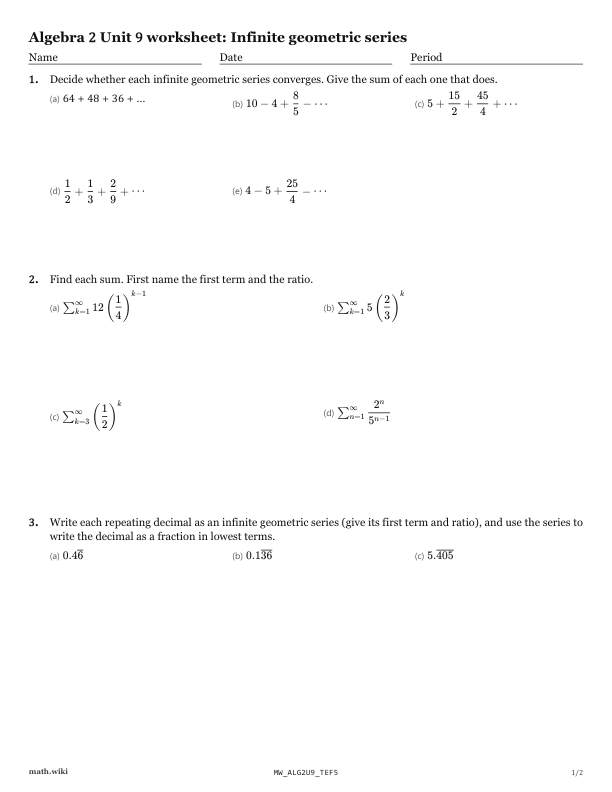
- Decide whether each infinite geometric series converges and give the sum if it does.64 + 48 + 36 + …10 - 4 + \dfrac{8}{5} - \cdots5 + \dfrac{15}{2} + \dfrac{45}{4} + \cdots\dfrac{1}{2} + \dfrac{1}{3} + \dfrac{2}{9} + \cdots4 - 5 + \dfrac{25}{4} - \cdots
- Find each sum, naming the first term and ratio first.\sum_{k=1}^{\infty} 12\left(\dfrac{1}{4}\right)^{k-1}\sum_{k=1}^{\infty} 5\left(\dfrac{2}{3}\right)^{k}\sum_{k=3}^{\infty} \left(\dfrac{1}{2}\right)^{k}\sum_{n=1}^{\infty} \dfrac{2^{n}}{5^{n-1}}
- Write each repeating decimal as an infinite geometric series and as a fraction.0.4\overline{6}0.1\overline{36}5.\overline{405}
- Word problem: a town grant spent over and over at local shops.
- Find the total of the areas or lengths in a pattern of squares joined at midpoints.
- Find the ratio when the first term is 3 times the sum of all the other terms.
Teach it first
The free lesson teaches it with worked examples and practice problems.
Infinite geometric series: the lesson ›More Chapter 9 worksheets: Sequences and series
- 9.1Sigma notation
- 9.2Arithmetic series and partial sums
- 9.3Geometric series
- 9.4Infinite geometric series
- 9.5Arithmetic sequences and the explicit formula
- 9.6Geometric sequences and the explicit formula