Page 1 of 2
Download
Get this sheet
SubscriptionOpen any sheet in any course, up to 40 a month, keys included. Or $40 month to month.
$25/mo, billed yearly
SubscribeTry one first: a free Chapter 1 worksheet (PDF, no sign-in).
What's on the worksheet
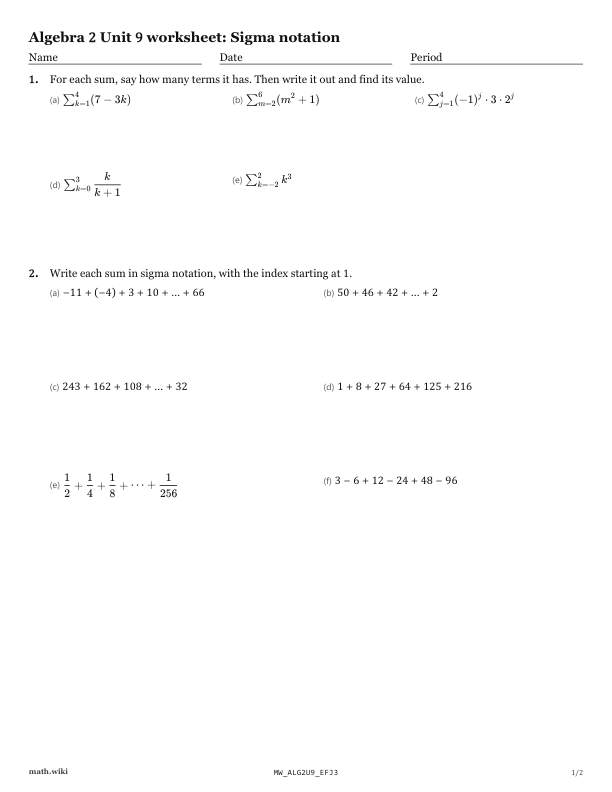
- For each sum, say how many terms it has, write it out and find its value.\sum_{k=1}^{4} (7 - 3k)\sum_{m=2}^{6} (m^2 + 1)\sum_{j=1}^{4} (-1)^j \cdot 3 \cdot 2^{j}\sum_{k=0}^{3} \dfrac{k}{k + 1}\sum_{k=-2}^{2} k^3
- Write each sum in sigma notation with the index starting at 1.−11 + (−4) + 3 + 10 + … + 6650 + 46 + 42 + … + 2243 + 162 + 108 + … + 321 + 8 + 27 + 64 + 125 + 216\dfrac{1}{2} + \dfrac{1}{4} + \dfrac{1}{8} + \cdots + \dfrac{1}{256}
- Rewrite a sum so the index starts at 1 and check the first and last terms.
- Use two given partial sums to find a sum of a transformed set of terms.
- Use the properties of sums with given totals of k and k squared.
- Check a student's rewrite of a sum with the index starting at 0.
Teach it first
The free lesson teaches it with worked examples and practice problems.
Sigma notation: the lesson ›