Page 1 of 3
Download
Get this sheet
SubscriptionOpen any sheet in any course, up to 40 a month, keys included. Or $40 month to month.
$25/mo, billed yearly
SubscribeTry one first: a free Chapter 1 worksheet (PDF, no sign-in).
What's on the worksheet
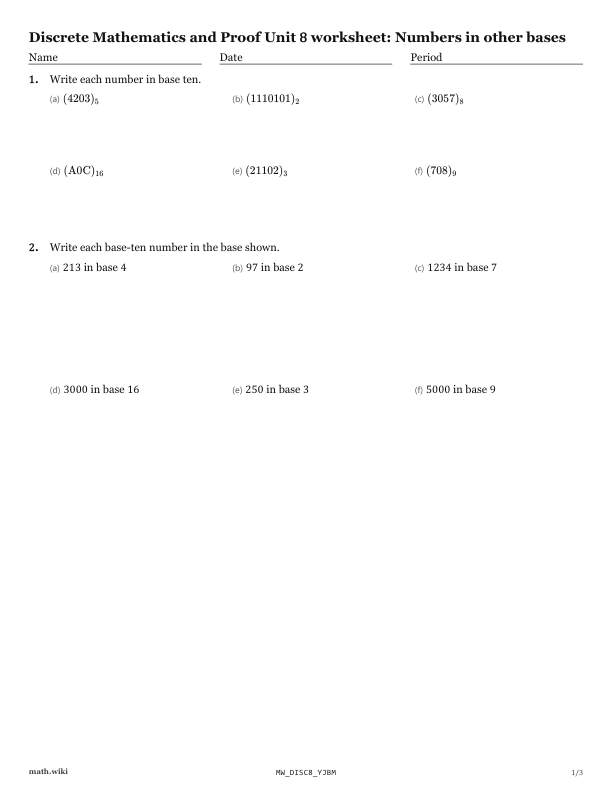
- Write each number in base ten.(4203)_5(1110101)_2(3057)_8(\mathrm{A0C})_{16}(21102)_3
- Write each base-ten number in the base shown.213 in base 497 in base 21234 in base 73000 in base 16250 in base 3
- A screen colour is stored as three levels, red, green and blue, each a whole number from 0 to 255.
- On many computers a file has nine permission switches, in three groups of three:
- Yuna turned a four-digit numeral into base ten in nested form:
- Jin finds the line (25)_b · (3)_b = (111)_b in an old puzzle book, in a base b the book does not name.
- Let b ≥ 3 be an integer.
Teach it first
The free lesson teaches it with worked examples and practice problems.
Numbers in other bases: the lesson ›More Chapter 8 worksheets: Number theory and modular arithmetic
- 8.1Every number has exactly one prime factorization
- 8.2The division algorithm
- 8.3Numbers in other bases
- 8.4The Euclidean algorithm and coprime numbers
- 8.5Bezout's identity and the extended Euclidean algorithm
- 8.6Congruence modulo n and its arithmetic
- 8.7Relations, equivalence classes and partitions
- 8.8Where the divisibility tests come from
- 8.9Powers modulo n
- 8.10Modular inverses and linear congruences
- 8.11The Chinese remainder theorem
- 8.12Fermat's little theorem
- 8.13RSA public-key encryption