Page 1 of 2
Download
Get this sheet
SubscriptionOpen any sheet in any course, up to 40 a month, keys included. Or $40 month to month.
$25/mo, billed yearly
SubscribeTry one first: a free Chapter 1 worksheet (PDF, no sign-in).
What's on the worksheet
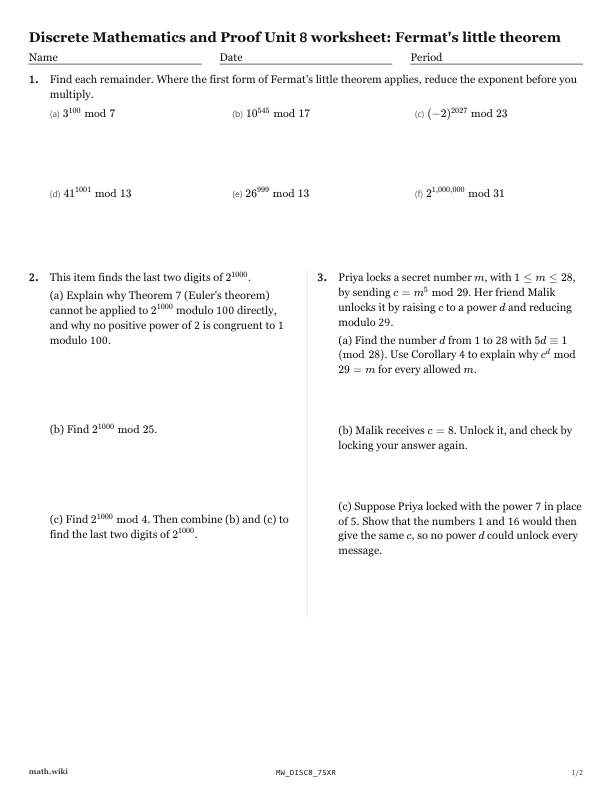
- Find each remainder.3^{100} \bmod 710^{545} \bmod 17(-2)^{2027} \bmod 2341^{1001} \bmod 1326^{999} \bmod 13
- This item finds the last two digits of 2^1000.
- Priya locks a secret number m, with 1 ≤ m ≤ 28, by sending c = m^5 29.
- A Fermat test on n = 21 picks a base a with 21 a, computes a²0 21, and proves 21 composite unless the result is 1.
- Let p be a prime, and let a and b be integers with a^p b^p p.
Teach it first
The free lesson teaches it with worked examples and practice problems.
Fermat's little theorem: the lesson ›More Chapter 8 worksheets: Number theory and modular arithmetic
- 8.1Every number has exactly one prime factorization
- 8.2The division algorithm
- 8.3Numbers in other bases
- 8.4The Euclidean algorithm and coprime numbers
- 8.5Bezout's identity and the extended Euclidean algorithm
- 8.6Congruence modulo n and its arithmetic
- 8.7Relations, equivalence classes and partitions
- 8.8Where the divisibility tests come from
- 8.9Powers modulo n
- 8.10Modular inverses and linear congruences
- 8.11The Chinese remainder theorem
- 8.12Fermat's little theorem
- 8.13RSA public-key encryption