Page 1 of 3
Download
Get this sheet
SubscriptionOpen any sheet in any course, up to 40 a month, keys included. Or $40 month to month.
$25/mo, billed yearly
SubscribeTry one first: a free Chapter 1 worksheet (PDF, no sign-in).
What's on the worksheet
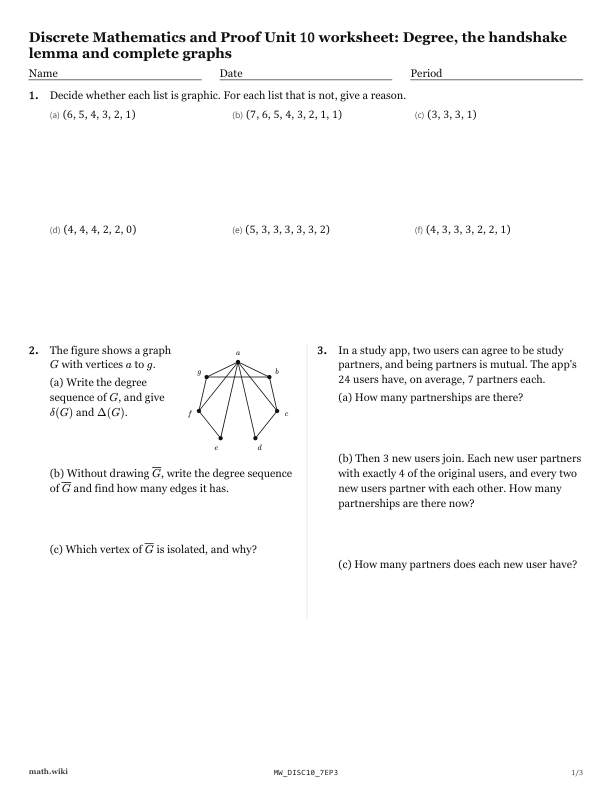
- Decide whether each list is graphic.(6, 5, 4, 3, 2, 1)(7, 6, 5, 4, 3, 2, 1, 1)(3, 3, 3, 1)(4, 4, 4, 2, 2, 0)(5, 3, 3, 3, 3, 3, 2)
- a b c d e f g The figure shows a graph G with vertices a to g.
- In a study app, two users can agree to be study partners, and being partners is mutual.
- Hannah's chess club has 12 players and is running a round robin:
- Seven weather stations A to G are to be joined by radio links, each link joining two stations, so that every station is linked directly to at least…
- At a workshop, every two of the people present shook hands exactly once.
- Let G be a graph with n vertices, and suppose that G and its complement G are both r-regular, for the same number r.
- Let n ≥ 2, and let G be an (n - 2)-regular graph on n vertices.
Teach it first
The free lesson teaches it with worked examples and practice problems.
Degree, the handshake lemma and complete graphs: the lesson ›More Chapter 10 worksheets: Graphs
- 10.1Degree, the handshake lemma and complete graphs
- 10.2Walks, paths, cycles and connected graphs
- 10.3Graph isomorphism: when two drawings are the same graph
- 10.4Euler paths and circuits
- 10.5Hamiltonian paths and cycles
- 10.6Trees
- 10.7Planar graphs and Euler's formula
- 10.8Graph coloring
- 10.9Bipartite graphs
- 10.10Weighted and directed graphs
- 10.11Finding a shortest path
- 10.12Spanning trees and minimum spanning trees
- 10.13Adjacency matrices and their powers