Page 1 of 3
Download
Get this sheet
SubscriptionOpen any sheet in any course, up to 40 a month, keys included. Or $40 month to month.
$25/mo, billed yearly
SubscribeTry one first: a free Chapter 1 worksheet (PDF, no sign-in).
What's on the worksheet
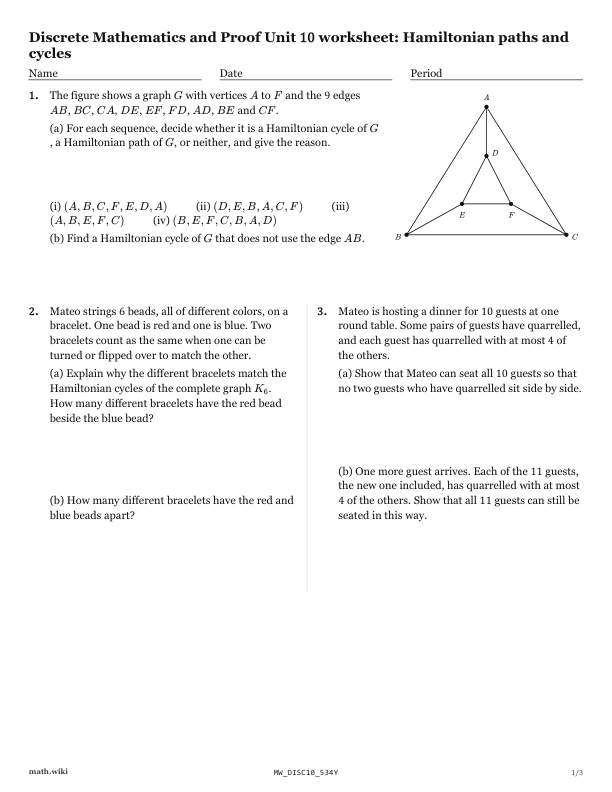
- A B C D E F The figure shows a graph G with vertices A to F and the 9 edges AB, BC, CA, DE, EF, FD, AD, BE and CF.
- Mateo strings 6 beads, all of different colors, on a bracelet.
- Mateo is hosting a dinner for 10 guests at one round table.
- A block of cheese is a 3 × 3 × 3 cube made of 27 small cubes, labeled (i, j, k) with i, j, k \1, 2, 3\.
- A pairing of a graph is a set of its edges, no two with a common end, such that every vertex is an end of one of them.
- Let 1 ≤ m < s, and let G be the graph with m red vertices r_1, , r_m and s blue vertices b_1, , b_s, in which every red vertex is joined to every…
Teach it first
The free lesson teaches it with worked examples and practice problems.
Hamiltonian paths and cycles: the lesson ›More Chapter 10 worksheets: Graphs
- 10.1Degree, the handshake lemma and complete graphs
- 10.2Walks, paths, cycles and connected graphs
- 10.3Graph isomorphism: when two drawings are the same graph
- 10.4Euler paths and circuits
- 10.5Hamiltonian paths and cycles
- 10.6Trees
- 10.7Planar graphs and Euler's formula
- 10.8Graph coloring
- 10.9Bipartite graphs
- 10.10Weighted and directed graphs
- 10.11Finding a shortest path
- 10.12Spanning trees and minimum spanning trees
- 10.13Adjacency matrices and their powers