Page 1 of 3
Download
Get this sheet
SubscriptionOpen any sheet in any course, up to 40 a month, keys included. Or $40 month to month.
$25/mo, billed yearly
SubscribeTry one first: a free Chapter 1 worksheet (PDF, no sign-in).
What's on the worksheet
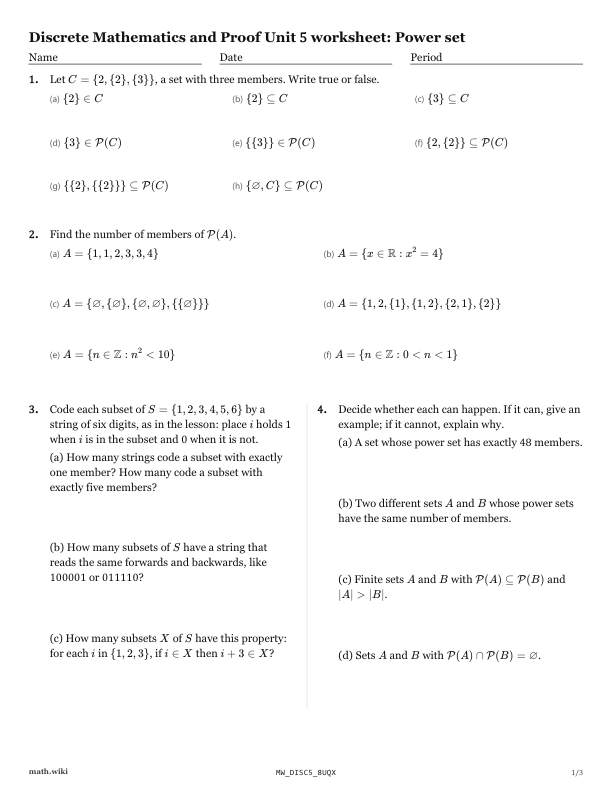
- Let C = \2, \2\, \3\\, a set with three members.\{2\} \in C\{2\} \subseteq C\{3\} \subseteq C\{3\} \in \mathcal{P}(C)\{\{3\}\} \in \mathcal{P}(C)
- Find the number of members of P(A).
- Code each subset of S = \1, 2, 3, 4, 5, 6\ by a string of six digits, as in the lesson:
- Decide whether each can happen.
- Let A be any set, and let a and b be any objects.
- Let A, B and X be sets.
- Prove by induction on n that, for every whole number n ≥ 0, a set with n members has exactly n(n - 1)2 subsets with exactly two members.
Teach it first
The free lesson teaches it with worked examples and practice problems.
Power set: the lesson ›More Chapter 5 worksheets: Sets, relations and functions
- 5.1Subsets, proper subsets and equal sets
- 5.2Power set
- 5.3Set identities: distributive and De Morgan laws
- 5.4Proving a set identity
- 5.5Cartesian product
- 5.6Relations and their properties: reflexive, symmetric, antisymmetric, transitive
- 5.7One-to-one, onto and bijective functions
- 5.8Composing functions between sets, and when an inverse exists