Page 1 of 4
Download
Get this sheet
SubscriptionOpen any sheet in any course, up to 40 a month, keys included. Or $40 month to month.
$25/mo, billed yearly
SubscribeTry one first: a free Chapter 1 worksheet (PDF, no sign-in).
What's on the worksheet
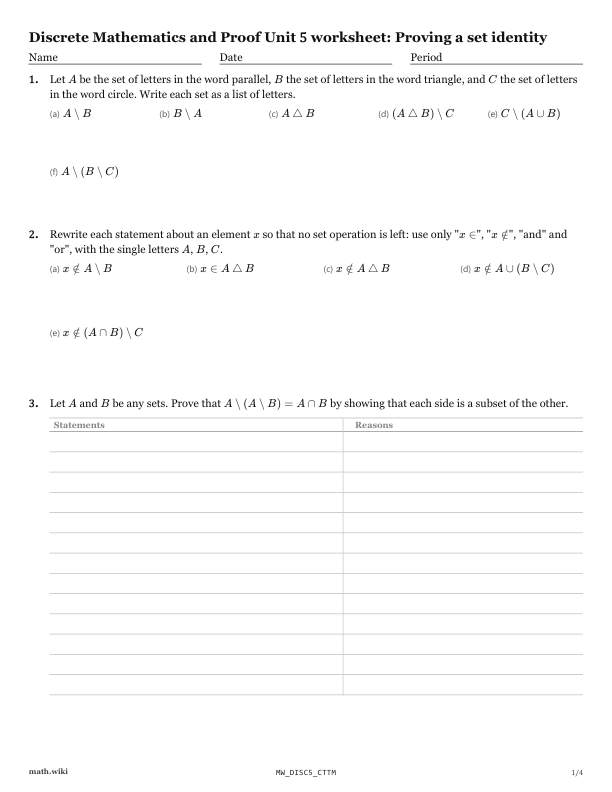
- Let A be the set of letters in the word parallel, B the set of letters in the word triangle, and C the set of letters in the word circle.A \setminus BB \setminus AA \mathbin{\triangle} B(A \mathbin{\triangle} B) \setminus CC \setminus (A \cup B)
- Rewrite each statement about an element x so that no set operation is left:x \notin A \setminus Bx \in A \mathbin{\triangle} Bx \notin A \mathbin{\triangle} Bx \notin A \cup (B \setminus C)x \notin (A \cap B) \setminus C
- Let A and B be any sets.
- Let A, B and C be any sets.
- Let A, B and C be any sets in a universal set U.
- Let A and B be any sets.
- A student guesses that union spreads over a difference the way it spreads over an intersection, so that A (B C) = (A B) (A C) for all sets A, B, C.
- Let A, B and C be sets with A C = B C and A C = B C.
Teach it first
The free lesson teaches it with worked examples and practice problems.
Proving a set identity: the lesson ›More Chapter 5 worksheets: Sets, relations and functions
- 5.1Subsets, proper subsets and equal sets
- 5.2Power set
- 5.3Set identities: distributive and De Morgan laws
- 5.4Proving a set identity
- 5.5Cartesian product
- 5.6Relations and their properties: reflexive, symmetric, antisymmetric, transitive
- 5.7One-to-one, onto and bijective functions
- 5.8Composing functions between sets, and when an inverse exists