Page 1 of 2
Download
Get this sheet
SubscriptionOpen any sheet in any course, up to 40 a month, keys included. Or $40 month to month.
$25/mo, billed yearly
SubscribeTry one first: a free Chapter 1 worksheet (PDF, no sign-in).
What's on the worksheet
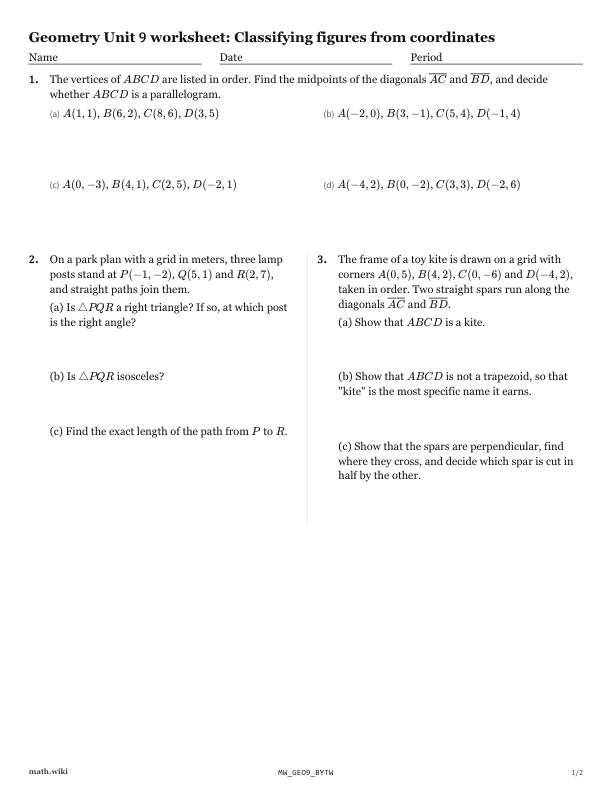
- Find the midpoints of the diagonals and decide whether each quadrilateral is a parallelogram.A(1, 1), B(6, 2), C(8, 6), D(3, 5)A(-2, 0), B(3, -1), C(5, 4), D(-1, 4)A(0, -3), B(4, 1), C(2, 5), D(-2, 1)A(-4, 2), B(0, -2), C(3, 3), D(-2, 6)
- Decide whether a triangle of lamp posts is right or isosceles and find its measures.
- Show a toy kite frame is a kite but not a rhombus.
- Explain why Noah's four points do not make a quadrilateral in that order and give a correct order.
- Give a quadrilateral that shows Maya's claim about diagonals is wrong.
- Use slopes to show a parallelogram is neither a rectangle nor a rhombus.
- Follow a hinged frame of four equal rods as it leans.
Teach it first
The free lesson teaches it with worked examples and practice problems.
Classifying figures from coordinates: the lesson ›More Chapter 9 worksheets: Coordinate geometry and coordinate proof
- 9.1Partitioning a segment in a given ratio
- 9.2Slopes of perpendicular lines
- 9.3Writing a parallel or perpendicular line through a point
- 9.4Perimeter and area from coordinates
- 9.5Classifying figures from coordinates
- 9.6Coordinate proofs with variables
- 9.7Flowchart proofs and choosing a format
- 9.8Coordinates and distance in three dimensions