Page 1 of 2
Download
Get this sheet
SubscriptionOpen any sheet in any course, up to 40 a month, keys included. Or $40 month to month.
$25/mo, billed yearly
SubscribeTry one first: a free Chapter 1 worksheet (PDF, no sign-in).
What's on the worksheet
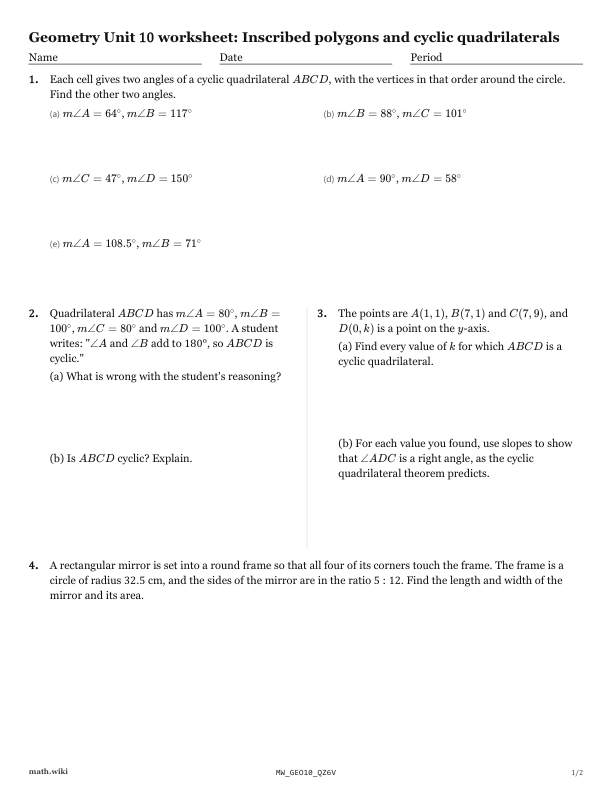
- Find the other two angles of a cyclic quadrilateral from two given angles.m\angle A = 64^\circ, m\angle B = 117^\circm\angle B = 88^\circ, m\angle C = 101^\circm\angle C = 47^\circ, m\angle D = 150^\circm\angle A = 90^\circ, m\angle D = 58^\circm\angle A = 108.5^\circ, m\angle B = 71^\circ
- Find what is wrong with a student's reasoning that a quadrilateral is cyclic.
- Find the values of k that make ABCD cyclic and check with slopes.
- Find the length, width and area of a rectangular mirror in a round frame.
- Find the missing angles of an inscribed octagon.
- Find angles of a cyclic quadrilateral from the angles on a diagonal.
- Prove a quadrilateral made by a segment parallel to the base of an isosceles triangle is cyclic.
Teach it first
The free lesson teaches it with worked examples and practice problems.
Inscribed polygons and cyclic quadrilaterals: the lesson ›More Chapter 10 worksheets: Circles
- 10.1Chords, secants and tangents
- 10.2Arcs and central angles
- 10.3Arc length
- 10.4Sectors, segments and their areas
- 10.5The inscribed angle theorem
- 10.6Inscribed polygons and cyclic quadrilaterals
- 10.7Proving the inscribed angle theorem
- 10.8Chord theorems
- 10.9Tangent properties
- 10.10Proving a tangent is perpendicular to the radius
- 10.11Angles made by chords, secants and tangents
- 10.12Segment lengths in circles
- 10.13Proving the power of a point relationships
- 10.14Regular polygons and their circles
- 10.15Equation of a circle
- 10.16Finding the center and radius