Page 1 of 2
Download
Get this sheet
SubscriptionOpen any sheet in any course, up to 40 a month, keys included. Or $40 month to month.
$25/mo, billed yearly
SubscribeTry one first: a free Chapter 1 worksheet (PDF, no sign-in).
What's on the worksheet
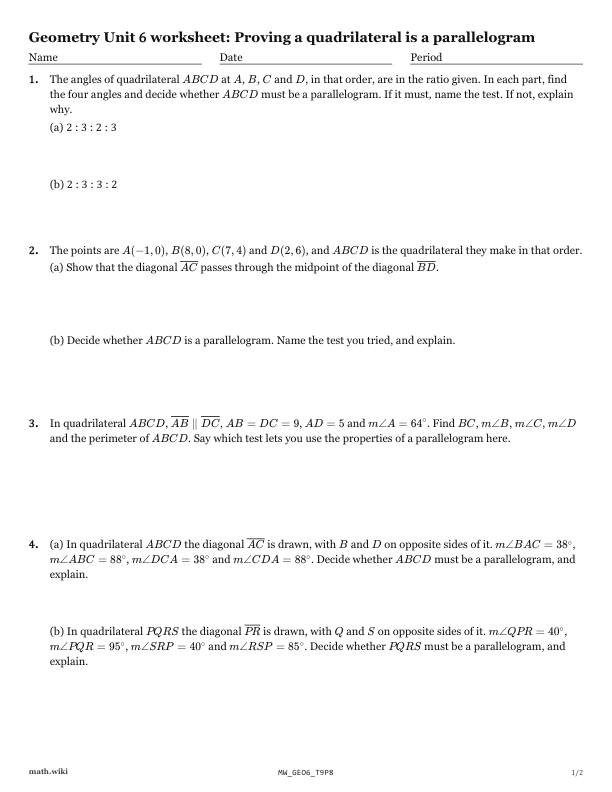
- Find the angles from a ratio and decide whether the quadrilateral must be a parallelogram.
- Show the diagonals share a midpoint and decide whether the quadrilateral is a parallelogram.
- Find the sides, angles and perimeter using one pair of equal parallel sides.
- Decide from angle measures whether two quadrilaterals must be parallelograms.
- Prove two segments bisect each other in a parallelogram with an extended side.
- Prove a slid triangle is congruent to the original.
Teach it first
The free lesson teaches it with worked examples and practice problems.
Proving a quadrilateral is a parallelogram: the lesson ›More Chapter 6 worksheets: Quadrilaterals and polygons
- 6.1Angle sums of polygons
- 6.2Regular polygons and their angles
- 6.3Tessellations
- 6.4Properties of a parallelogram
- 6.5Proving properties of a parallelogram
- 6.6Proving a quadrilateral is a parallelogram
- 6.7Rectangles, rhombuses and squares
- 6.8Proving a parallelogram is a rectangle or a rhombus
- 6.9Trapezoids and kites
- 6.10Proving properties of an isosceles trapezoid
- 6.11Midsegments of triangles and trapezoids
- 6.12The quadrilateral family tree