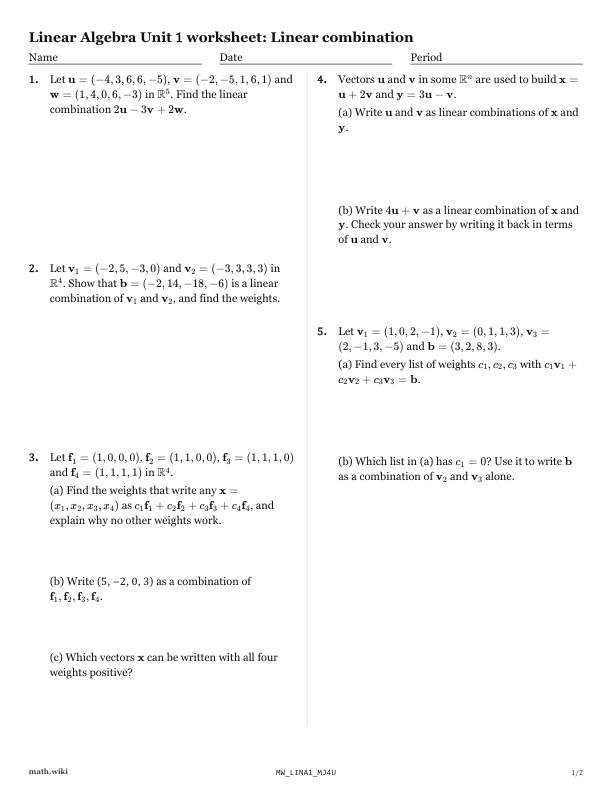
Page 1 of 2
Download, free
The full Linear Algebra courseEvery lesson in teaching order, with over 170 printables.See the course ›What's on the worksheet
- Let u = (-4, 3, 6, 6, -5), v = (-2, -5, 1, 6, 1) and w = (1, 4, 0, 6, -3) in R^5.
- Let v_1 = (-2, 5, -3, 0) and v_2 = (-3, 3, 3, 3) in R^4.
- Let f_1 = (1, 0, 0, 0), f_2 = (1, 1, 0, 0), f_3 = (1, 1, 1, 0) and f_4 = (1, 1, 1, 1) in R^4.
- Vectors u and v in some R^n are used to build x = u + 2v and y = 3u - v.
- Let v_1 = (1, 0, 2, -1), v_2 = (0, 1, 1, 3), v_3 = (2, -1, 3, -5) and b = (3, 2, 8, 3).
- Mei's embroidery machine moves its needle by whole stitches of two kinds, a = (3, 2) and b = (1, 3), in millimeters (across, up).
- Let v_1, v_2 and b be vectors in R^n with b = c_1v_1 + c_2v_2.
Teach it first
The free lesson teaches it with worked examples and practice problems.
Linear combination: the lesson ›More Chapter 1 worksheets: Vectors in n dimensions
- 1.1Adding and scaling vectors in n dimensions
- 1.2Dot product, length and orthogonality in n dimensions
- 1.3Linear combination
- 1.4Span
- 1.5Linear independence
- 1.6Subspaces
- 1.7Basis and dimension