Page 1 of 2
Download, free
The full Linear Algebra courseEvery lesson in teaching order, with over 170 printables.See the course ›What's on the worksheet
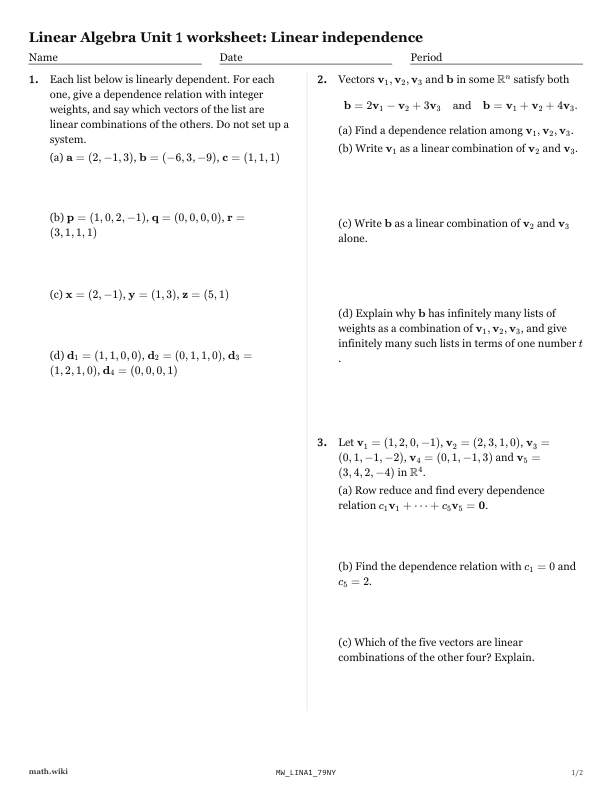
- Each list below is linearly dependent.
- Vectors v_1, v_2, v_3 and b in some R^n satisfy both \mathbf{b} = 2\mathbf{v}_1 - \mathbf{v}_2 + 3\mathbf{v}_3 \quad \text{and} \quad \mathbf{b} =…
- Let v_1 = (1, 2, 0, -1), v_2 = (2, 3, 1, 0), v_3 = (0, 1, -1, -2), v_4 = (0, 1, -1, 3) and v_5 = (3, 4, 2, -4) in R^4.
- Show by row reduction that v_1 = (1, -2, -3, 1, -3), v_2 = (1, 0, 1, 3, 3) and v_3 = (6, -4, -2, 14, 6) in R^5 are linearly dependent.
- Let v_1, , v_k be a linearly independent list in R^n, and let w be a vector of R^n that is not a linear combination of v_1, , v_k.
Teach it first
The free lesson teaches it with worked examples and practice problems.
Linear independence: the lesson ›More Chapter 1 worksheets: Vectors in n dimensions
- 1.1Adding and scaling vectors in n dimensions
- 1.2Dot product, length and orthogonality in n dimensions
- 1.3Linear combination
- 1.4Span
- 1.5Linear independence
- 1.6Subspaces
- 1.7Basis and dimension