Page 1 of 2
Download, free
The full Math 6 courseEvery lesson in teaching order, with over 400 printables.See the course ›What's on the worksheet
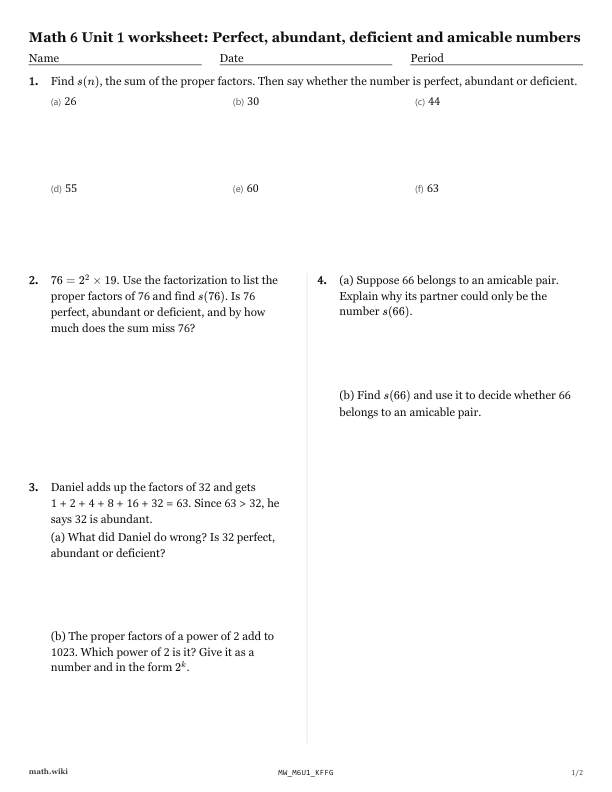
- Find the sum of the proper factors of each number, then call it perfect, abundant or deficient.2630445560
- Use a factorization of 76 to list its proper factors and classify it.
- Find Daniel's mistake when he adds up all the factors of 32 and calls it abundant.
- Explain why a partner of 66 must be its factor sum, then decide if 66 is in an amicable pair.
- Use a factorization of 120 to list all its factors and find its factor sum.
- Explain why the square of a prime is always deficient.
- Classify numbers by using multiples of perfect and abundant numbers, or by finding the factor sum.
Teach it first
The free lesson teaches it with worked examples and practice problems.
Perfect, abundant, deficient and amicable numbers: the lesson ›More Chapter 1 worksheets: Factors, multiples, GCF and LCM
- 1.1Tests for three and nine
- 1.2The sieve of Eratosthenes
- 1.3Prime factorization
- 1.4Every number has exactly one prime factorization
- 1.5Greatest common factor by listing
- 1.6Least common multiple by listing
- 1.7Finding them from prime factorizations
- 1.8Perfect, abundant, deficient and amicable numbers