Page 1 of 2
Download
Get this sheet
SubscriptionOpen any sheet in any course, up to 40 a month, keys included. Or $40 month to month.
$25/mo, billed yearly
SubscribeTry one first: a free Chapter 1 worksheet (PDF, no sign-in).
What's on the worksheet
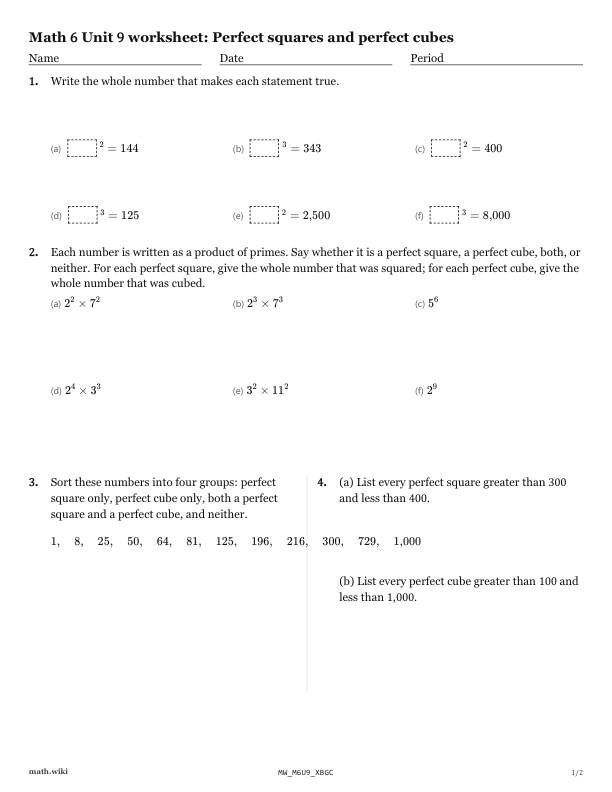
- Write the whole number that makes each statement true.
- Use each prime factorization to tell if the number is a perfect square, cube, both or neither.2^2 \times 7^22^3 \times 7^35^62^4 \times 3^33^2 \times 11^2
- Sort numbers into perfect square only, cube only, both, and neither.
- List perfect squares between 300 and 400 and perfect cubes between 100 and 1,000.
- Word problem: count blue and clear panes in a square window.
- Word problem: count painted faces on small cubes in a large cube dipped in paint.
- Find the sum of odd numbers from 1 to 21 and show it with a growing square of dots.
- Test Jack's claim about doubling the side of a square.
Teach it first
The free lesson teaches it with worked examples and practice problems.
Perfect squares and perfect cubes: the lesson ›More Chapter 9 worksheets: Exponents and expressions
- 9.1Base, exponent and the value of a power
- 9.2Perfect squares and perfect cubes
- 9.3Order of operations with powers
- 9.4What a letter stands for
- 9.5Translating between words and expressions
- 9.6Terms, coefficients and constants
- 9.7Expression, equation and inequality
- 9.8Evaluating expressions and formulas
- 9.9Equivalent expressions: the distributive property and like terms