Page 1 of 3
Download
Get this sheet
SubscriptionOpen any sheet in any course, up to 40 a month, keys included. Or $40 month to month.
$25/mo, billed yearly
SubscribeTry one first: a free Chapter 1 worksheet (PDF, no sign-in).
What's on the worksheet
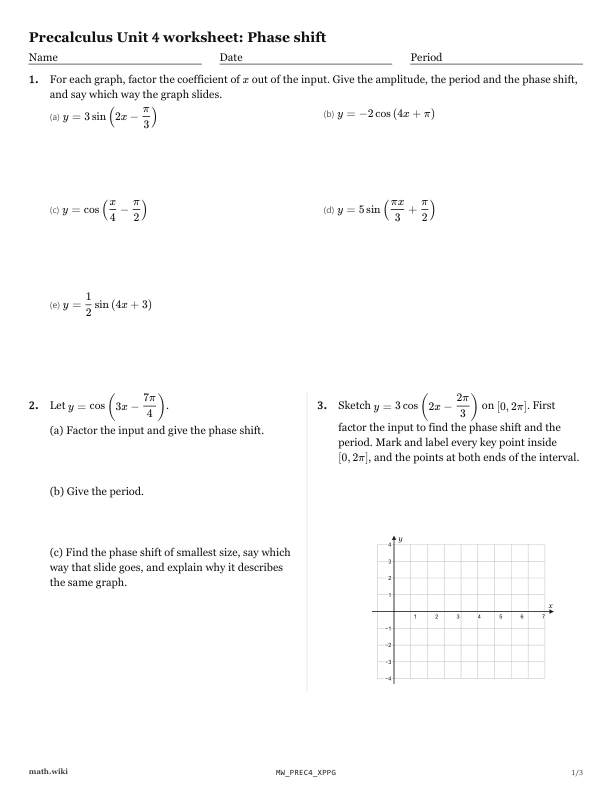
- For each graph, factor the coefficient of x out of the input.y = 3\sin\left(2x - \dfrac{\pi}{3}\right)y = -2\cos\left(4x + \pi\right)y = \cos\left(\dfrac{x}{4} - \dfrac{\pi}{2}\right)y = 5\sin\left(\dfrac{\pi x}{3} + \dfrac{\pi}{2}\right)y = \dfrac{1}{2}\sin\left(4x + 3\right)
- Let y = (3x - 7 π4).
- Sketch y = 3(2x - 2π3) on [0, 2π].
- The graph of y = 3x is slid sideways, and the new graph is written as y = (3x - d) with 0 ≤ d < 2π.
- Diego rewrites y = (π4 - 2x) as y = (-2(x + π8)) and says the graph is y = (-2x) slid π8 to the left.
- A sailboat on a mooring rolls from side to side.
Teach it first
The free lesson teaches it with worked examples and practice problems.
Phase shift: the lesson ›More Chapter 4 worksheets: Trigonometric functions and their graphs
- 4.1Periodic functions
- 4.2Graphing sine and cosine
- 4.3Amplitude and reflection
- 4.4Finding the period from the equation
- 4.5Phase shift
- 4.6Midline and vertical shift
- 4.7Writing an equation from a wave
- 4.8Graphing tangent and the reciprocal functions
- 4.9Inverse trig functions
- 4.10Composing trig and inverse trig functions
- 4.11Height on a turning wheel
- 4.12Tides, daylight and sound
- 4.13Simple harmonic motion