Page 1 of 2
Download
Get this sheet
SubscriptionOpen any sheet in any course, up to 40 a month, keys included. Or $40 month to month.
$25/mo, billed yearly
SubscribeTry one first: a free Chapter 1 worksheet (PDF, no sign-in).
What's on the worksheet
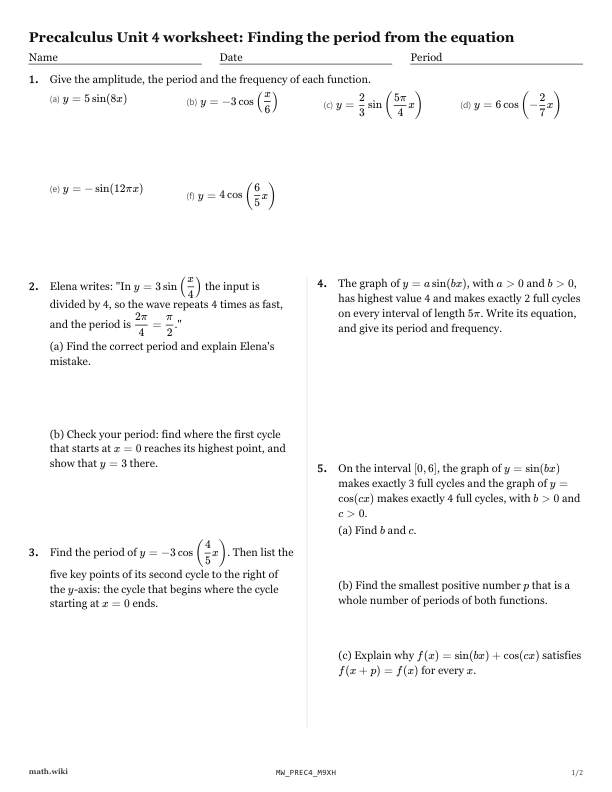
- Give the amplitude, the period and the frequency of each function.y = 5\sin(8x)y = -3\cos\left(\dfrac{x}{6}\right)y = \dfrac{2}{3}\sin\left(\dfrac{5\pi}{4}x\right)y = 6\cos\left(-\dfrac{2}{7}x\right)y = -\sin(12\pi x)
- Elena writes:
- Find the period of y = -3(45x).
- The graph of y = a(bx), with a > 0 and b > 0, has highest value 4 and makes exactly 2 full cycles on every interval of length 5 π.
- On the interval [0, 6], the graph of y = (bx) makes exactly 3 full cycles and the graph of y = (cx) makes exactly 4 full cycles, with b > 0 and c > 0.
- The figure shows the graph of y = (bx) for some number b > 0.
- Isaac's desk fan turns its head from side to side.
Teach it first
The free lesson teaches it with worked examples and practice problems.
Finding the period from the equation: the lesson ›More Chapter 4 worksheets: Trigonometric functions and their graphs
- 4.1Periodic functions
- 4.2Graphing sine and cosine
- 4.3Amplitude and reflection
- 4.4Finding the period from the equation
- 4.5Phase shift
- 4.6Midline and vertical shift
- 4.7Writing an equation from a wave
- 4.8Graphing tangent and the reciprocal functions
- 4.9Inverse trig functions
- 4.10Composing trig and inverse trig functions
- 4.11Height on a turning wheel
- 4.12Tides, daylight and sound
- 4.13Simple harmonic motion