Page 1 of 2
Download
Get this sheet
SubscriptionOpen any sheet in any course, up to 40 a month, keys included. Or $40 month to month.
$25/mo, billed yearly
SubscribeTry one first: a free Chapter 1 worksheet (PDF, no sign-in).
What's on the worksheet
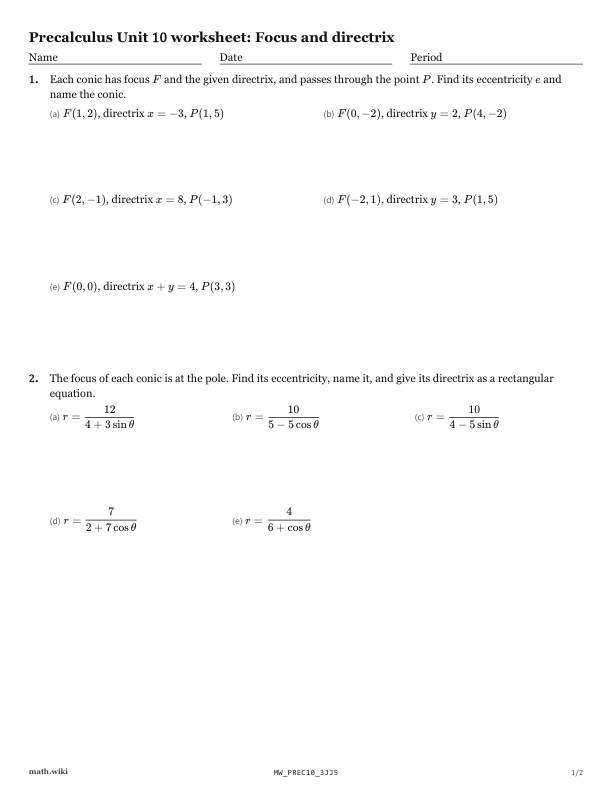
- Each conic has focus F and the given directrix, and passes through the point P.F(1, 2), directrix x = -3, P(1, 5)F(0, -2), directrix y = 2, P(4, -2)F(2, -1), directrix x = 8, P(-1, 3)F(-2, 1), directrix y = 3, P(1, 5)F(0, 0), directrix x + y = 4, P(3, 3)
- The focus of each conic is at the pole.r = \dfrac{12}{4 + 3\sin\theta}r = \dfrac{10}{5 - 5\cos\theta}r = \dfrac{10}{4 - 5\sin\theta}r = \dfrac{7}{2 + 7\cos\theta}r = \dfrac{4}{6 + \cos\theta}
- A conic has focus F(0, -3), directrix x = 9 and eccentricity e = 23.
- A conic has its focus at the origin and eccentricity e = 13.
- A conic has its focus F at the origin and a vertical directrix x = d.
- A conic has its focus at the pole, eccentricity e = 32, and a directrix x = d with d > 0.
Teach it first
The free lesson teaches it with worked examples and practice problems.
Focus and directrix: the lesson ›More Chapter 10 worksheets: Conic sections
- 10.1Equation of a circle
- 10.2Finding the center and radius
- 10.3Conic sections from a double cone
- 10.4Focus and directrix
- 10.5The parabola as a locus
- 10.6The ellipse
- 10.7The hyperbola
- 10.8Identifying and translating conics