Page 1 of 2
Download
Get this sheet
SubscriptionOpen any sheet in any course, up to 40 a month, keys included. Or $40 month to month.
$25/mo, billed yearly
SubscribeTry one first: a free Chapter 1 worksheet (PDF, no sign-in).
What's on the worksheet
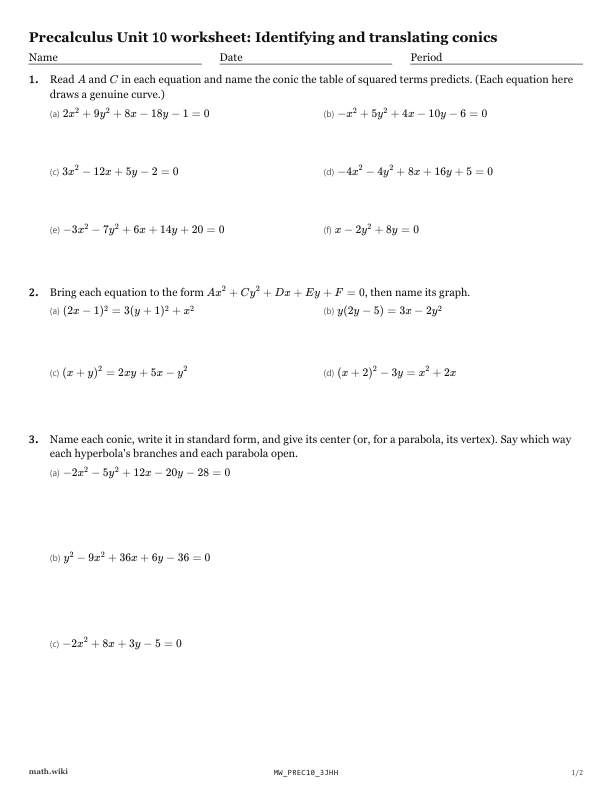
- Read A and C in each equation and name the conic the table of squared terms predicts.2x^2 + 9y^2 + 8x - 18y - 1 = 0-x^2 + 5y^2 + 4x - 10y - 6 = 03x^2 - 12x + 5y - 2 = 0-4x^2 - 4y^2 + 8x + 16y + 5 = 0-3x^2 - 7y^2 + 6x + 14y + 20 = 0
- Bring each equation to the form Ax² + Cy² + Dx + Ey + F = 0, then name its graph.(2x - 1)^2 = 3(y + 1)^2 + x^2y(2y - 5) = 3x - 2y^2(x + y)^2 = 2xy + 5x - y^2(x + 2)^2 - 3y = x^2 + 2x
- Name each conic, write it in standard form, and give its center (or, for a parabola, its vertex).-2x^2 - 5y^2 + 12x - 20y - 28 = 0y^2 - 9x^2 + 36x + 6y - 36 = 0-2x^2 + 8x + 3y - 5 = 0
- For each real number k, consider (k - 1)x² + (5 - k)y² + 4x - 6y - 2 = 0. Here both squared coefficients move with k.
- Write an equation Ax² + Cy² + Dx + Ey + F = 0 with integer coefficients whose graph is exactly the given pair of lines.
- Prove that if A and C have opposite signs, the graph of Ax² + Cy² + Dx + Ey + F = 0 contains at least one point, whatever the numbers D, E and F are.
Teach it first
The free lesson teaches it with worked examples and practice problems.
Identifying and translating conics: the lesson ›More Chapter 10 worksheets: Conic sections
- 10.1Equation of a circle
- 10.2Finding the center and radius
- 10.3Conic sections from a double cone
- 10.4Focus and directrix
- 10.5The parabola as a locus
- 10.6The ellipse
- 10.7The hyperbola
- 10.8Identifying and translating conics