Page 1 of 2
Download
Get this sheet
SubscriptionOpen any sheet in any course, up to 40 a month, keys included. Or $40 month to month.
$25/mo, billed yearly
SubscribeTry one first: a free Chapter 1 worksheet (PDF, no sign-in).
What's on the worksheet
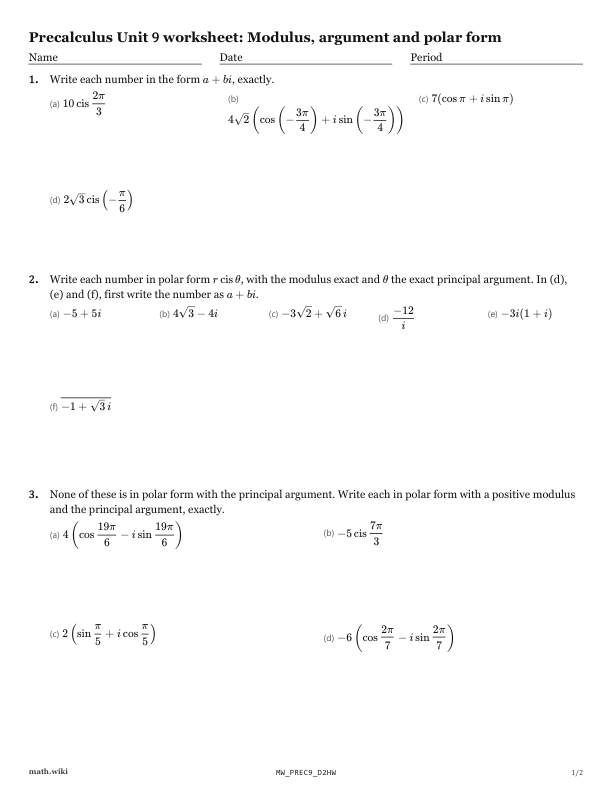
- Write each number in the form a + bi, exactly.
- Write each number in polar form rcisθ, with the modulus exact and θ the exact principal argument.-5 + 5i4\sqrt{3} - 4i-3\sqrt{2} + \sqrt{6}\,i\dfrac{-12}{i}-3i(1 + i)
- None of these is in polar form with the principal argument.4\left(\cos\dfrac{19\pi}{6} - i\sin\dfrac{19\pi}{6}\right)-5\operatorname{cis}\dfrac{7\pi}{3}2\left(\sin\dfrac{\pi}{5} + i\cos\dfrac{\pi}{5}\right)-6\left(\cos\dfrac{2\pi}{7} - i\sin\dfrac{2\pi}{7}\right)
- Write z = (2 - 3i)² in the form a + bi.
- Let z = -52 - 5√(3)2\,i.
- Let k be a nonzero real number and z = -k + k√(3)\,i.
Teach it first
The free lesson teaches it with worked examples and practice problems.
Modulus, argument and polar form: the lesson ›More Chapter 9 worksheets: Polar coordinates and complex numbers in polar form
- 9.1Adding, subtracting and multiplying complex numbers
- 9.2Plotting polar points
- 9.3Converting between polar and rectangular
- 9.4Converting an equation between the two systems
- 9.5Polar circles and symmetry tests
- 9.6Limacons and cardioids
- 9.7Rose curves
- 9.8The complex plane, modulus and argument
- 9.9Modulus, argument and polar form
- 9.10Multiplying, powers and De Moivre's theorem
- 9.11Roots of a complex number and roots of unity