Page 1 of 2
Download
Get this sheet
SubscriptionOpen any sheet in any course, up to 40 a month, keys included. Or $40 month to month.
$25/mo, billed yearly
SubscribeTry one first: a free Chapter 1 worksheet (PDF, no sign-in).
What's on the worksheet
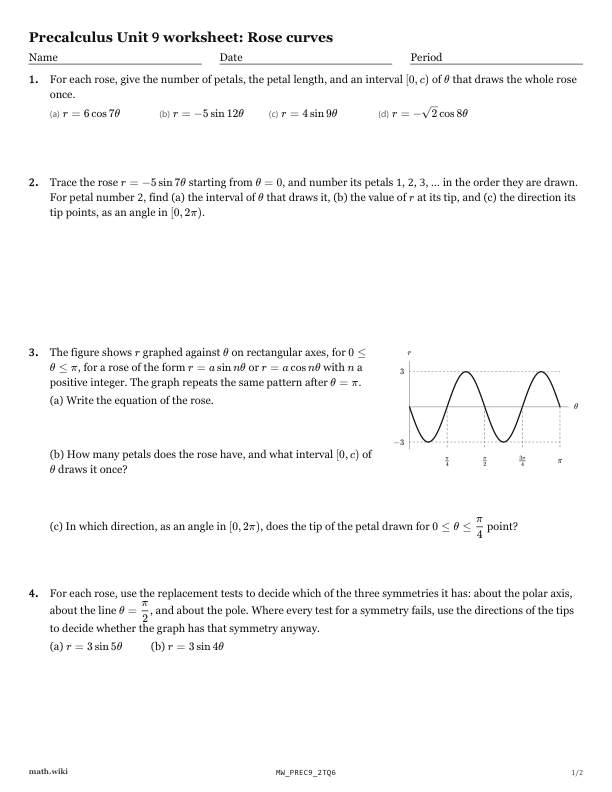
- For each rose, give the number of petals, the petal length, and an interval [0, c) of θ that draws the whole rose once.r = 6\cos 7\thetar = -5\sin 12\thetar = 4\sin 9\thetar = -\sqrt{2}\cos 8\theta
- Trace the rose r = -5 7θ starting from θ = 0, and number its petals 1, 2, 3, … in the order they are drawn.
- \frac{\pi}{4} \frac{\pi}{2} \frac{3\pi}{4} \pi 3 -3 \theta r The figure shows r graphed against θ on rectangular axes, for 0 ≤ θ ≤ π, for a rose of…
- For each rose, use the replacement tests to decide which of the three symmetries it has:
- On the polar grid, sketch the rose r = -4 3θ.
- The rose r = 6 4θ has a petal whose tip points in the direction 3π8.
- The rose r = 5 nθ, with n a positive integer, first reaches the pole at θ = π12:
Teach it first
The free lesson teaches it with worked examples and practice problems.
Rose curves: the lesson ›More Chapter 9 worksheets: Polar coordinates and complex numbers in polar form
- 9.1Adding, subtracting and multiplying complex numbers
- 9.2Plotting polar points
- 9.3Converting between polar and rectangular
- 9.4Converting an equation between the two systems
- 9.5Polar circles and symmetry tests
- 9.6Limacons and cardioids
- 9.7Rose curves
- 9.8The complex plane, modulus and argument
- 9.9Modulus, argument and polar form
- 9.10Multiplying, powers and De Moivre's theorem
- 9.11Roots of a complex number and roots of unity