Page 1 of 3
Download
Get this sheet
SubscriptionOpen any sheet in any course, up to 40 a month, keys included. Or $40 month to month.
$25/mo, billed yearly
SubscribeTry one first: a free Chapter 1 worksheet (PDF, no sign-in).
What's on the worksheet
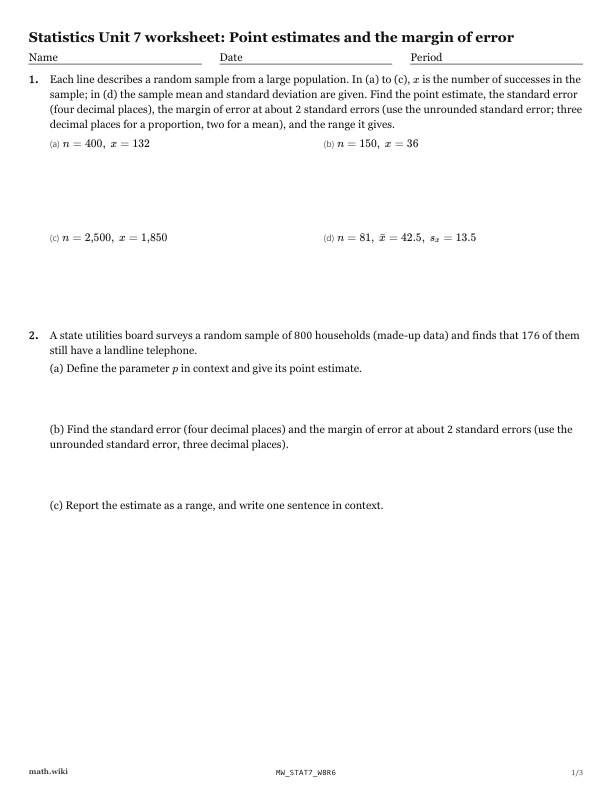
- Each line describes a random sample from a large population.n = 400,\ x = 132n = 150,\ x = 36n = 2{,}500,\ x = 1{,}850n = 81,\ \bar{x} = 42.5,\ s_x = 13.5
- A state utilities board surveys a random sample of 800 households (made-up data) and finds that 176 of them still have a landline telephone.
- A state poll reports that between 41% and 47% of the state's adults want to stay on standard time all year.
- A city's recycling office weighs one week of food waste from a random sample of 100 households (made-up data).
- A state wildlife agency polls a random sample of 625 licensed hunters each year and reports one margin of error, plus or minus 4 percentage points,…
- A school district asks families whether they favor a four-day school week (made-up data).
Teach it first
The free lesson teaches it with worked examples and practice problems.
Point estimates and the margin of error: the lesson ›More Chapter 7 worksheets: Inference for proportions: confidence intervals
- 7.1Standard error
- 7.2Point estimates and the margin of error
- 7.3Confidence level and interpreting an interval
- 7.4Critical value
- 7.5Conditions for one proportion
- 7.6One sample interval for a proportion and sample size
- 7.7Interval for a difference of proportions