Page 1 of 3
Download
Get this sheet
SubscriptionOpen any sheet in any course, up to 40 a month, keys included. Or $40 month to month.
$25/mo, billed yearly
SubscribeTry one first: a free Chapter 1 worksheet (PDF, no sign-in).
What's on the worksheet
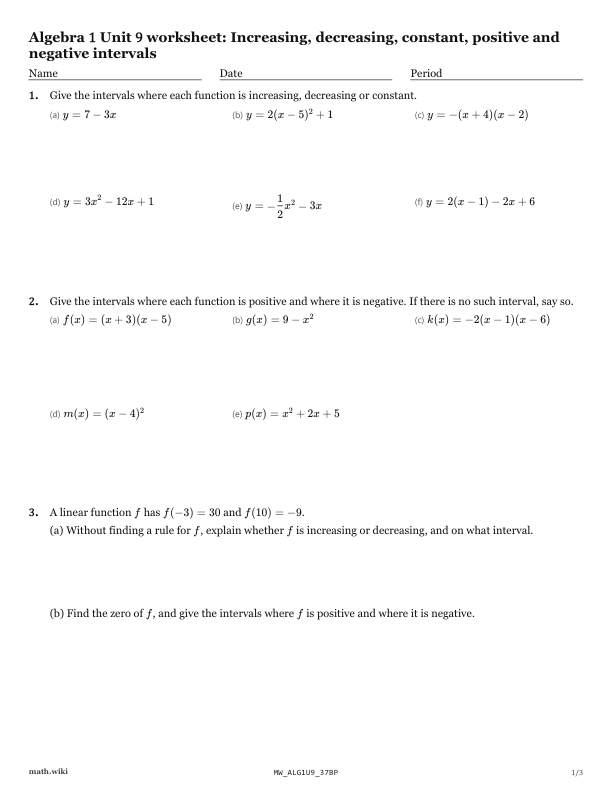
- Give the intervals where each function is increasing, decreasing or constant.y = 7 - 3xy = 2(x - 5)^2 + 1y = -(x + 4)(x - 2)y = 3x^2 - 12x + 1y = -\dfrac{1}{2}x^2 - 3x
- Give the intervals where each function is positive and where it is negative.f(x) = (x + 3)(x - 5)g(x) = 9 - x^2k(x) = -2(x - 1)(x - 6)m(x) = (x - 4)^2p(x) = x^2 + 2x + 5
- Decide whether a linear function is increasing or decreasing from two values.
- Check Mei's claim that increasing implies positive.
- Write a quadratic rule with stated increasing, decreasing, positive and negative intervals.
- Read the intervals from a graph made of straight pieces.
- A gannet dives: use the height over time to describe its dive.
Teach it first
The free lesson teaches it with worked examples and practice problems.
Increasing, decreasing, constant, positive and negative intervals: the lesson ›More Chapter 9 worksheets: Quadratic functions and their graphs
- 9.1What makes an expression quadratic
- 9.2The shape of a parabola
- 9.3The vertex and the axis of symmetry
- 9.4Graphing from standard form
- 9.5Roots, zeros and x-intercepts
- 9.6Intercepts and zeros of a function
- 9.7Increasing, decreasing, constant, positive and negative intervals
- 9.8Turning points, maximums and minimums
- 9.9Maximum, minimum and range of a quadratic function
- 9.10Quadratic functions in context