Page 1 of 2
Download
Get this sheet
SubscriptionOpen any sheet in any course, up to 40 a month, keys included. Or $40 month to month.
$25/mo, billed yearly
SubscribeTry one first: a free Chapter 1 worksheet (PDF, no sign-in).
What's on the worksheet
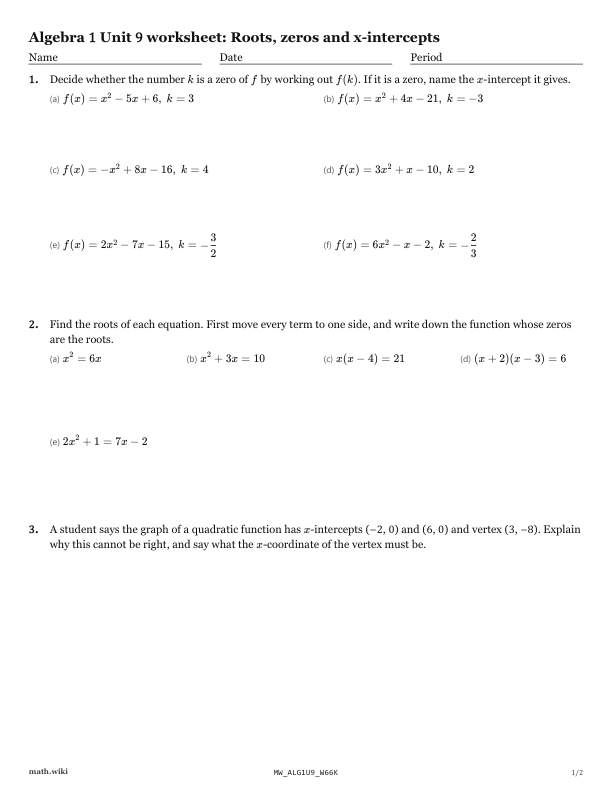
- Decide whether each number is a zero of the function and name the x-intercept.f(x) = x^2 - 5x + 6,\; k = 3f(x) = x^2 + 4x - 21,\; k = -3f(x) = -x^2 + 8x - 16,\; k = 4f(x) = 3x^2 + x - 10,\; k = 2f(x) = 2x^2 - 7x - 15,\; k = -\dfrac{3}{2}
- Find the roots of each equation after moving every term to one side.x^2 = 6xx^2 + 3x = 10x(x - 4) = 21(x + 2)(x - 3) = 62x^2 + 1 = 7x - 2
- Explain why a student's described intercepts and vertex cannot be right.
- Hannah's raised garden bed: find the width from the area.
- Find the zeros of new functions made from one with zeros at negative one and four.
- Use a table of values and a known intercept to find the other x-intercept.
Teach it first
The free lesson teaches it with worked examples and practice problems.
Roots, zeros and x-intercepts: the lesson ›More Chapter 9 worksheets: Quadratic functions and their graphs
- 9.1What makes an expression quadratic
- 9.2The shape of a parabola
- 9.3The vertex and the axis of symmetry
- 9.4Graphing from standard form
- 9.5Roots, zeros and x-intercepts
- 9.6Intercepts and zeros of a function
- 9.7Increasing, decreasing, constant, positive and negative intervals
- 9.8Turning points, maximums and minimums
- 9.9Maximum, minimum and range of a quadratic function
- 9.10Quadratic functions in context