Page 1 of 3
Download
Get this sheet
SubscriptionOpen any sheet in any course, up to 40 a month, keys included. Or $40 month to month.
$25/mo, billed yearly
SubscribeTry one first: a free Chapter 1 worksheet (PDF, no sign-in).
What's on the worksheet
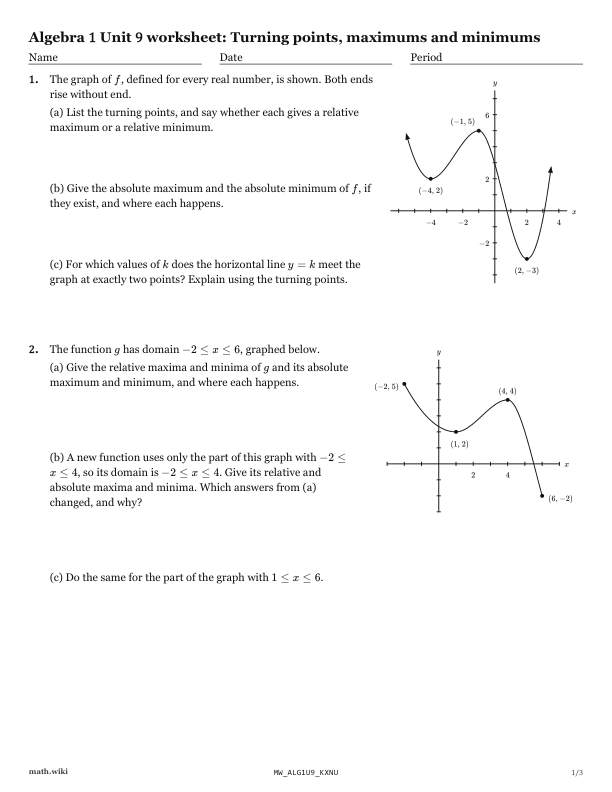
- List the relative maxima and minima of a graph that rises at both ends.
- Give the relative and absolute extremes of a function on a limited domain.
- Cyclist's heart rate table: find the highest and lowest values and the turning points.
- Find relative and absolute extremes of each function on the domain given.f(x) = 3 - 2x, \;\; -1 < x \le 4g(x) = (x - 5)^2, \;\; 0 \le x \le 3h(x) = x^2 - 1, \;\; -1 \le x < 2k(x) = 2 - (x + 1)^2, \;\; -3 < x \le 1
- Use the known peak and valley to find the extremes of a function on a limited domain.
- Decide whether each statement about extremes is always, sometimes or never true.
Teach it first
The free lesson teaches it with worked examples and practice problems.
Turning points, maximums and minimums: the lesson ›More Chapter 9 worksheets: Quadratic functions and their graphs
- 9.1What makes an expression quadratic
- 9.2The shape of a parabola
- 9.3The vertex and the axis of symmetry
- 9.4Graphing from standard form
- 9.5Roots, zeros and x-intercepts
- 9.6Intercepts and zeros of a function
- 9.7Increasing, decreasing, constant, positive and negative intervals
- 9.8Turning points, maximums and minimums
- 9.9Maximum, minimum and range of a quadratic function
- 9.10Quadratic functions in context