Page 1 of 3
Download
Get this sheet
SubscriptionOpen any sheet in any course, up to 40 a month, keys included. Or $40 month to month.
$25/mo, billed yearly
SubscribeTry one first: a free Chapter 1 worksheet (PDF, no sign-in).
What's on the worksheet
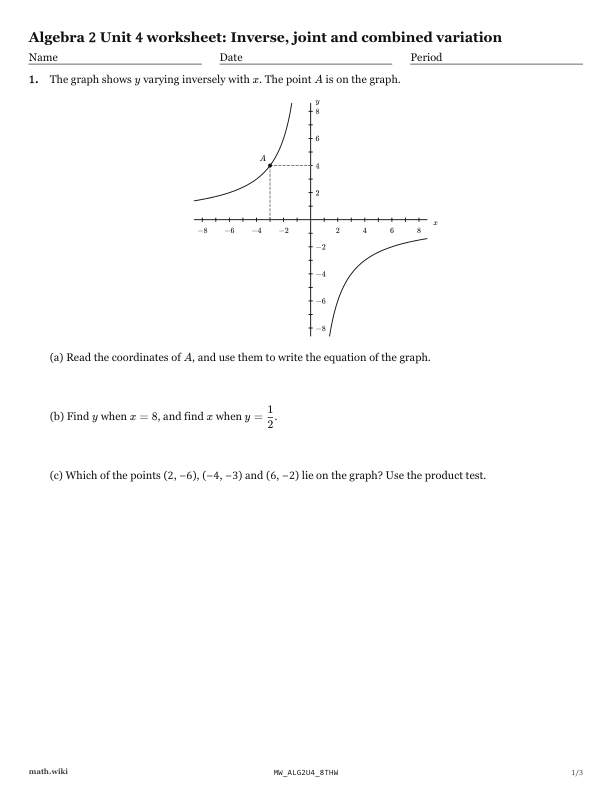
- Read the point on the graph and write the inverse variation equation.
- Say by what number the output is multiplied when the input changes as described.y = \dfrac{k}{x}, and x is multiplied by 5.y = \dfrac{k}{x^2}, and x is divided by 3.y = \dfrac{k}{\sqrt{x}}, and x is multiplied by 4.z = kxy, x is tripled and y is multiplied by \dfrac{2}{3}.w = \dfrac{kx^2}{y^3}, and x and y are both doubled.
- Find the two values of x, the constant and the equation from a change in y.
- Decide for each table if y varies directly, inversely, with a square or not at all, and write the equation.
- Word problem: wind force on a sign, varying jointly with its area and the square of the wind speed.
- Word problem: the resistance of a copper wire by length and diameter.
Teach it first
The free lesson teaches it with worked examples and practice problems.
Inverse, joint and combined variation: the lesson ›More Chapter 4 worksheets: Rational expressions and rational functions
- 4.1Simplifying a rational expression and where it is undefined
- 4.2Multiplying and dividing rational expressions
- 4.3Adding and subtracting rational expressions
- 4.4Solving a rational equation
- 4.5The implied domain of a formula
- 4.6Continuous graphs, jumps and holes
- 4.7Inverse, joint and combined variation
- 4.8Transforming the reciprocal graph
- 4.9Domain and zeros of a rational function
- 4.10Vertical asymptotes
- 4.11Horizontal asymptotes
- 4.12Graphing rational functions
- 4.13Rational functions in context