Page 1 of 2
Download
Get this sheet
SubscriptionOpen any sheet in any course, up to 40 a month, keys included. Or $40 month to month.
$25/mo, billed yearly
SubscribeTry one first: a free Chapter 1 worksheet (PDF, no sign-in).
What's on the worksheet
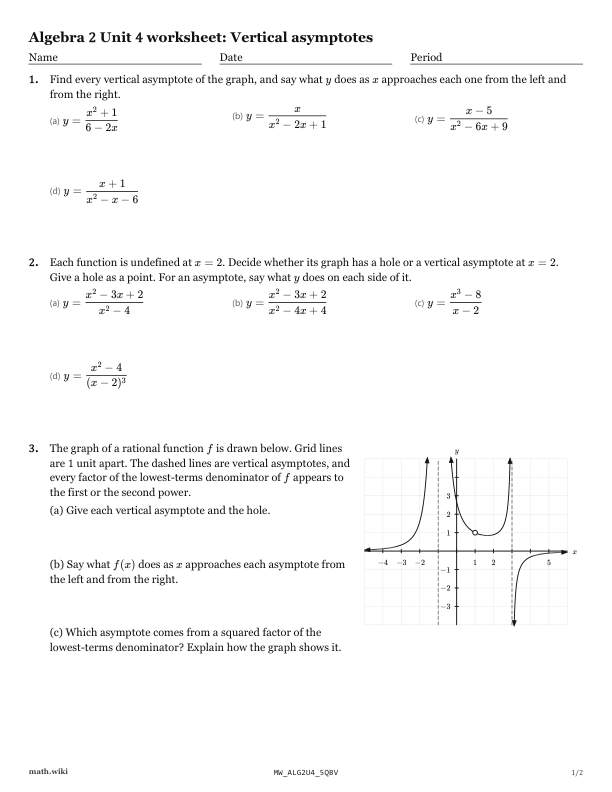
- Find every vertical asymptote and what y does approaching it from each side.y = \dfrac{x^2 + 1}{6 - 2x}y = \dfrac{x}{x^2 - 2x + 1}y = \dfrac{x - 5}{x^2 - 6x + 9}y = \dfrac{x + 1}{x^2 - x - 6}
- Decide whether each function has a hole or an asymptote at x equal to 2.y = \dfrac{x^2 - 3x + 2}{x^2 - 4}y = \dfrac{x^2 - 3x + 2}{x^2 - 4x + 4}y = \dfrac{x^3 - 8}{x - 2}y = \dfrac{x^2 - 4}{(x - 2)^3}
- Read the rule of the rational function from the graph with its dashed asymptotes.
- Write a rational function of least degree with the stated asymptotes and features.
- Word problem: the pitch heard from a jet flying toward a listener.
- Decide hole or asymptote at x equal to 3 for different powers on top and bottom.
Teach it first
The free lesson teaches it with worked examples and practice problems.
Vertical asymptotes: the lesson ›More Chapter 4 worksheets: Rational expressions and rational functions
- 4.1Simplifying a rational expression and where it is undefined
- 4.2Multiplying and dividing rational expressions
- 4.3Adding and subtracting rational expressions
- 4.4Solving a rational equation
- 4.5The implied domain of a formula
- 4.6Continuous graphs, jumps and holes
- 4.7Inverse, joint and combined variation
- 4.8Transforming the reciprocal graph
- 4.9Domain and zeros of a rational function
- 4.10Vertical asymptotes
- 4.11Horizontal asymptotes
- 4.12Graphing rational functions
- 4.13Rational functions in context