Page 1 of 2
Download, free
The full Calculus 1 courseEvery lesson in teaching order, with over 300 printables.See the course ›What's on the worksheet
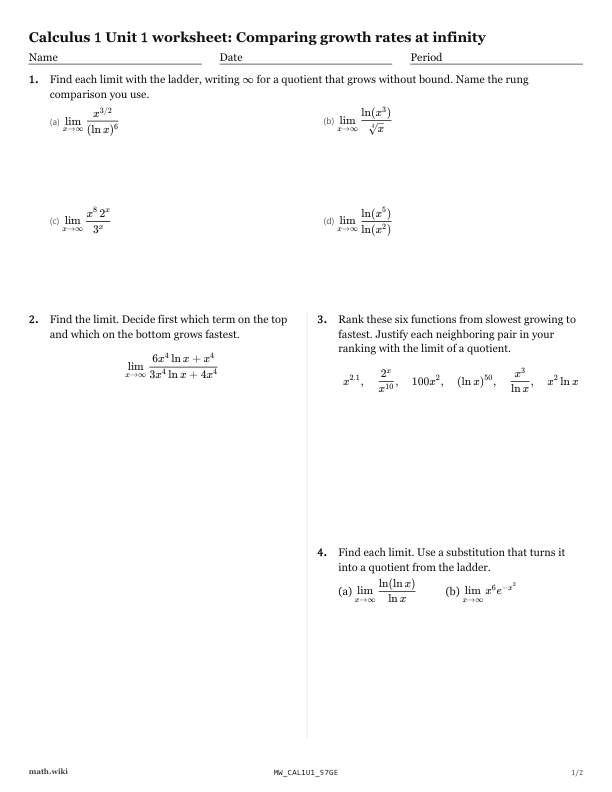
- Find each limit with the ladder, writing ∞ for a quotient that grows without bound.\displaystyle \lim_{x \to \infty} \dfrac{x^{3/2}}{(\ln x)^6}\displaystyle \lim_{x \to \infty} \dfrac{\ln(x^3)}{\sqrt[4]{x}}\displaystyle \lim_{x \to \infty} \dfrac{x^8\, 2^x}{3^x}\displaystyle \lim_{x \to \infty} \dfrac{\ln(x^5)}{\ln(x^2)}
- Find the limit.
- Rank these six functions from slowest growing to fastest.
- Find each limit.
- Layla tracks two videos she posted online.
- Samir makes three claims.
Teach it first
The free lesson teaches it with worked examples and practice problems.
Comparing growth rates at infinity: the lesson ›More Chapter 1 worksheets: Limits and continuity
- 1.1What a limit is: graphs and tables
- 1.2One sided limits and when a limit exists
- 1.3The limit laws
- 1.4Limits by algebra: factoring and rationalizing
- 1.5The squeeze theorem and the limit of sine x over x
- 1.6Continuity at a point
- 1.7Continuity on an interval
- 1.8Infinite limits and vertical asymptotes
- 1.9Discontinuities and how to remove them
- 1.10Making a piecewise function continuous
- 1.11Limits at infinity and horizontal asymptotes
- 1.12Comparing growth rates at infinity
- 1.13The intermediate value theorem
- 1.14The epsilon delta definition of a limit