Page 1 of 2
Download, free
The full Calculus 1 courseEvery lesson in teaching order, with over 300 printables.See the course ›What's on the worksheet
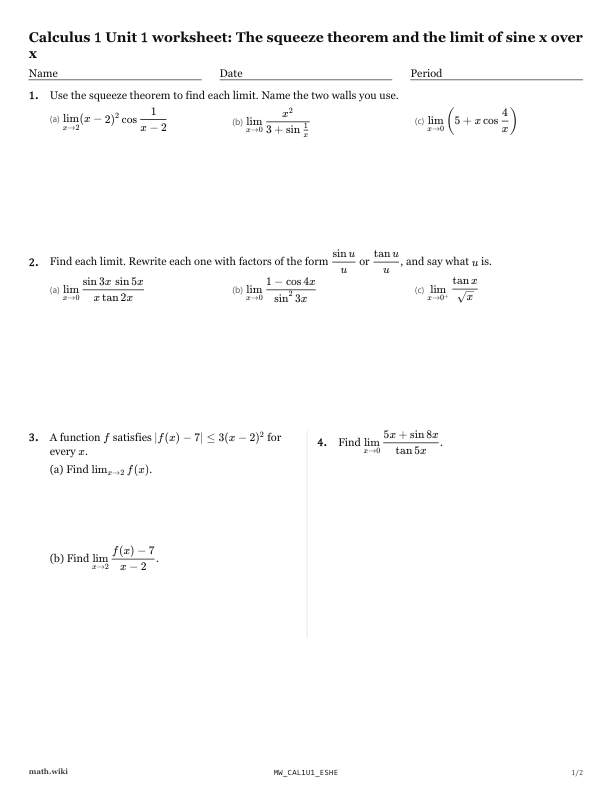
- Use the squeeze theorem to find each limit.\displaystyle \lim_{x \to 2} (x - 2)^2 \cos \dfrac{1}{x - 2}\displaystyle \lim_{x \to 0} \dfrac{x^2}{3 + \sin \frac{1}{x}}\displaystyle \lim_{x \to 0} \left(5 + x \cos \dfrac{4}{x}\right)
- Find each limit.\displaystyle \lim_{x \to 0} \dfrac{\sin 3x \, \sin 5x}{x \tan 2x}\displaystyle \lim_{x \to 0} \dfrac{1 - \cos 4x}{\sin^2 3x}\displaystyle \lim_{x \to 0^+} \dfrac{\tan x}{\sqrt{x}}
- A function f satisfies $|f
- Find _x 0 5x + 8x 5x.
- Find _x 3 2π xx² - 9.
- Priya draws a regular polygon with n sides inside a circle of radius 6 cm, with every corner on the circle.
- All that Mateo knows about a function f is that $0 \le f
Teach it first
The free lesson teaches it with worked examples and practice problems.
The squeeze theorem and the limit of sine x over x: the lesson ›More Chapter 1 worksheets: Limits and continuity
- 1.1What a limit is: graphs and tables
- 1.2One sided limits and when a limit exists
- 1.3The limit laws
- 1.4Limits by algebra: factoring and rationalizing
- 1.5The squeeze theorem and the limit of sine x over x
- 1.6Continuity at a point
- 1.7Continuity on an interval
- 1.8Infinite limits and vertical asymptotes
- 1.9Discontinuities and how to remove them
- 1.10Making a piecewise function continuous
- 1.11Limits at infinity and horizontal asymptotes
- 1.12Comparing growth rates at infinity
- 1.13The intermediate value theorem
- 1.14The epsilon delta definition of a limit