Page 1 of 2
Download, free
The full Calculus 1 courseEvery lesson in teaching order, with over 300 printables.See the course ›What's on the worksheet
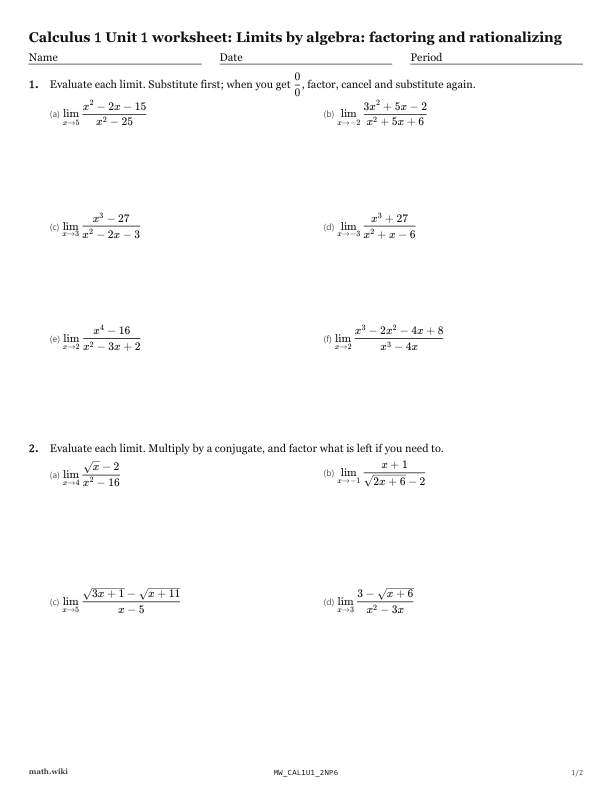
- Evaluate each limit.\displaystyle \lim_{x \to 5} \dfrac{x^2 - 2x - 15}{x^2 - 25}\displaystyle \lim_{x \to -2} \dfrac{3x^2 + 5x - 2}{x^2 + 5x + 6}\displaystyle \lim_{x \to 3} \dfrac{x^3 - 27}{x^2 - 2x - 3}\displaystyle \lim_{x \to -3} \dfrac{x^3 + 27}{x^2 + x - 6}\displaystyle \lim_{x \to 2} \dfrac{x^4 - 16}{x^2 - 3x + 2}
- Evaluate each limit.
- Expand the numerator, cancel the factor h, and evaluate the limit.
- Combine the fractions in the numerator, then evaluate each limit.
- Evaluate the limit below, and explain why multiplying by one conjugate is not enough.
- Ava evaluates _x -2 x² + 3x + 2x² + 4x + 4.
Teach it first
The free lesson teaches it with worked examples and practice problems.
Limits by algebra: factoring and rationalizing: the lesson ›More Chapter 1 worksheets: Limits and continuity
- 1.1What a limit is: graphs and tables
- 1.2One sided limits and when a limit exists
- 1.3The limit laws
- 1.4Limits by algebra: factoring and rationalizing
- 1.5The squeeze theorem and the limit of sine x over x
- 1.6Continuity at a point
- 1.7Continuity on an interval
- 1.8Infinite limits and vertical asymptotes
- 1.9Discontinuities and how to remove them
- 1.10Making a piecewise function continuous
- 1.11Limits at infinity and horizontal asymptotes
- 1.12Comparing growth rates at infinity
- 1.13The intermediate value theorem
- 1.14The epsilon delta definition of a limit