Page 1 of 2
Download
Get this sheet
SubscriptionOpen any sheet in any course, up to 40 a month, keys included. Or $40 month to month.
$25/mo, billed yearly
SubscribeTry one first: a free Chapter 1 worksheet (PDF, no sign-in).
What's on the worksheet
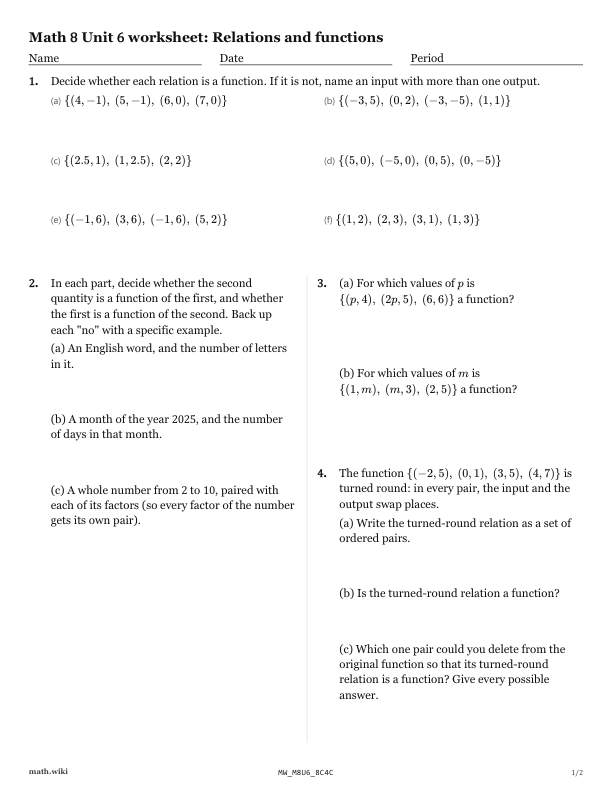
- Decide if each relation is a function and name an input with more than one output:\{(4, -1),\ (5, -1),\ (6, 0),\ (7, 0)\}\{(-3, 5),\ (0, 2),\ (-3, -5),\ (1, 1)\}\{(2.5, 1),\ (1, 2.5),\ (2, 2)\}\{(5, 0),\ (-5, 0),\ (0, 5),\ (0, -5)\}\{(-1, 6),\ (3, 6),\ (-1, 6),\ (5, 2)\}
- Decide if each quantity is a function of the other, with a reason for each no.
- Find the values of p and m that make a set of pairs a function.
- Turn a function round by swapping inputs and outputs, and decide if it is still a function.
- Write Andre's relation of whole numbers 1 to 4 with x less than y as ordered pairs.
- Decide if Samir is right about a table with five rows and three inputs.
- Use a zoo's feeding chart of enclosures, animals and food as relations.
Teach it first
The free lesson teaches it with worked examples and practice problems.
Relations and functions: the lesson ›More Chapter 6 worksheets: Functions
- 6.1Relations and functions
- 6.2Domain and range from pairs and tables
- 6.3Graphing a function from a table
- 6.4Testing graphs and equations for functions
- 6.5Evaluating a function at a number
- 6.6Reading values off a graph
- 6.7Constant rate of change and linear tables
- 6.8Reading a linear function from its graph
- 6.9Linear and nonlinear functions
- 6.10Comparing linear functions given different ways
- 6.11Graphs that tell a story