Page 1 of 2
Download
Get this sheet
SubscriptionOpen any sheet in any course, up to 40 a month, keys included. Or $40 month to month.
$25/mo, billed yearly
SubscribeTry one first: a free Chapter 1 worksheet (PDF, no sign-in).
What's on the worksheet
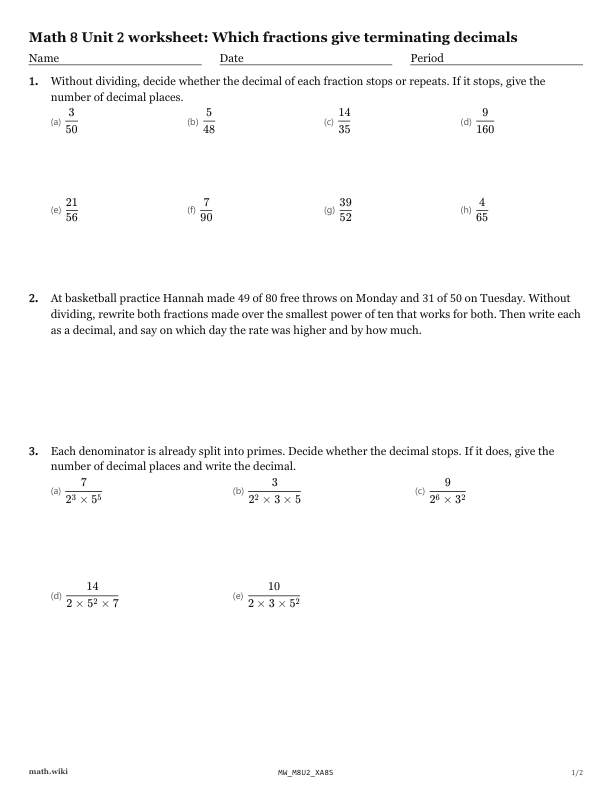
- Without dividing, decide if each decimal stops or repeats, and count the places:\dfrac{3}{50}\dfrac{5}{48}\dfrac{14}{35}\dfrac{9}{160}\dfrac{21}{56}
- Word problem: compare Hannah's free throw fractions by rewriting them over the same denominator.
- Use split denominators to decide if the decimal stops, and write it:\dfrac{7}{2^3 \times 5^5}\dfrac{3}{2^2 \times 3 \times 5}\dfrac{9}{2^6 \times 3^2}\dfrac{14}{2 \times 5^2 \times 7}\dfrac{10}{2 \times 3 \times 5^2}
- Write each sum or difference as one fraction, then decide if its decimal stops:
- Explain Kofi's mistake about the number of decimal places for 3 over 80.
- Find the smallest and largest denominators with exactly 4 decimal places.
Teach it first
The free lesson teaches it with worked examples and practice problems.
Which fractions give terminating decimals: the lesson ›More Chapter 2 worksheets: Roots, irrational numbers and the real numbers
- 2.1Which fractions give terminating decimals
- 2.2Turning a repeating decimal into a fraction
- 2.3Square roots
- 2.4Cube roots and higher roots
- 2.5Irrational numbers
- 2.6Approximating irrational numbers
- 2.7The real number line
- 2.8Sorting a number into its sets
- 2.9Terminating and repeating decimals