Page 1 of 2
Download
Get this sheet
SubscriptionOpen any sheet in any course, up to 40 a month, keys included. Or $40 month to month.
$25/mo, billed yearly
SubscribeTry one first: a free Chapter 1 worksheet (PDF, no sign-in).
What's on the worksheet
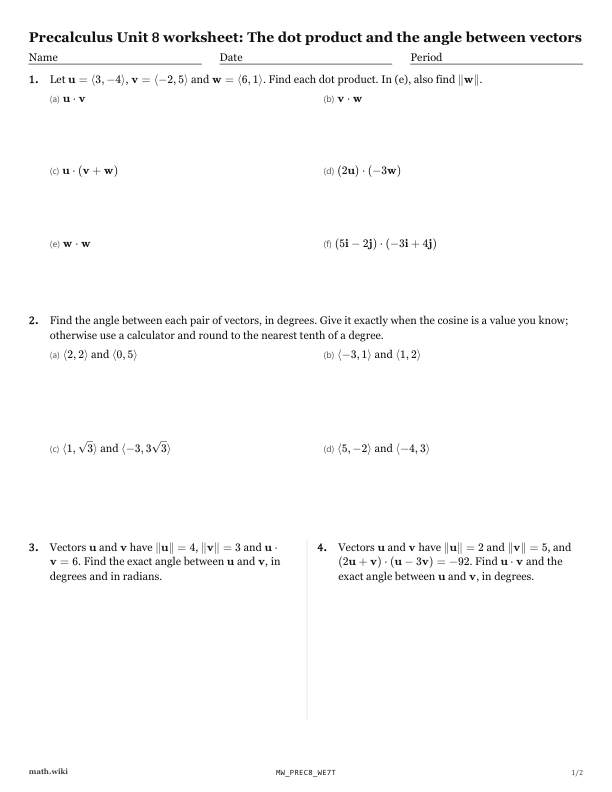
- Let u = 3, -4, v = -2, 5 and w = 6, 1.\mathbf{u} \cdot \mathbf{v}\mathbf{v} \cdot \mathbf{w}\mathbf{u} \cdot (\mathbf{v} + \mathbf{w})(2\mathbf{u}) \cdot (-3\mathbf{w})\mathbf{w} \cdot \mathbf{w}
- Find the angle between each pair of vectors, in degrees.\langle 2, 2 \rangle and \langle 0, 5 \rangle\langle -3, 1 \rangle and \langle 1, 2 \rangle\langle 1, \sqrt{3} \rangle and \langle -3, 3\sqrt{3} \rangle\langle 5, -2 \rangle and \langle -4, 3 \rangle
- Vectors u and v have \|u\| = 4, \|v\| = 3 and u · v = 6.
- Vectors u and v have \|u\| = 2 and \|v\| = 5, and (2u + v) · (u - 3v) = -92.
- Vectors u and v have \|u\| = 3 and \|u + v\| = 3 √(3), and the angle between u and v is 2 π3 radians.
- Let u = t, 3 and v = t, -1, where t is a real number.
- A triangle has vertices A(-1, 0), B(5, 2) and C(1, 3).
Teach it first
The free lesson teaches it with worked examples and practice problems.
The dot product and the angle between vectors: the lesson ›More Chapter 8 worksheets: Vectors and parametric equations
- 8.1Directed line segments
- 8.2Component form of a vector
- 8.3Magnitude and direction of a vector
- 8.4Unit vectors and i, j notation
- 8.5Scaling a vector
- 8.6Adding and subtracting vectors
- 8.7Forces and velocities as vectors
- 8.8The dot product and the angle between vectors
- 8.9Orthogonal vectors
- 8.10Vector and scalar projection
- 8.11Vectors in space
- 8.12Parametric equations
- 8.13Eliminating the parameter