Page 1 of 2
Download
Get this sheet
SubscriptionOpen any sheet in any course, up to 40 a month, keys included. Or $40 month to month.
$25/mo, billed yearly
SubscribeTry one first: a free Chapter 1 worksheet (PDF, no sign-in).
What's on the worksheet
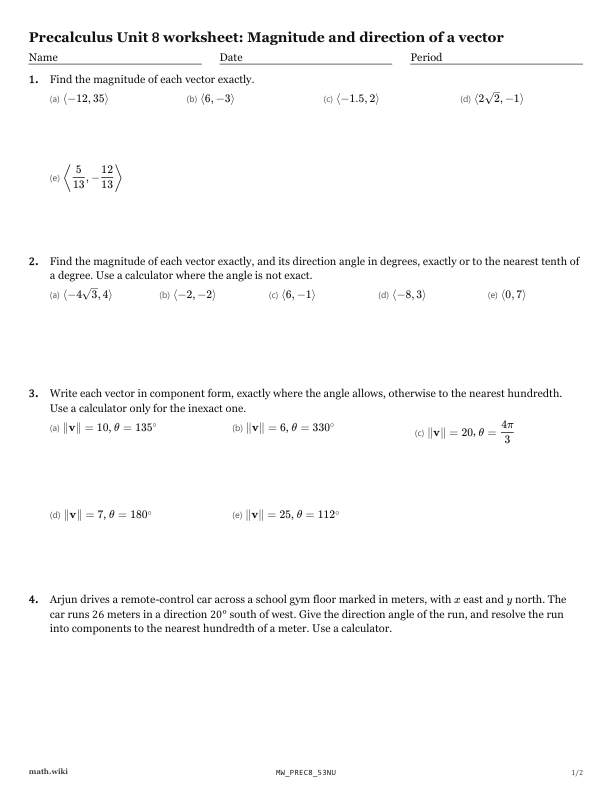
- Find the magnitude of each vector exactly.\langle -12, 35 \rangle\langle 6, -3 \rangle\langle -1.5, 2 \rangle\langle 2\sqrt{2}, -1 \rangle\left\langle \dfrac{5}{13}, -\dfrac{12}{13} \right\rangle
- Find the magnitude of each vector exactly, and its direction angle in degrees, exactly or to the nearest tenth of a degree.\langle -4\sqrt{3}, 4 \rangle\langle -2, -2 \rangle\langle 6, -1 \rangle\langle -8, 3 \rangle\langle 0, 7 \rangle
- Write each vector in component form, exactly where the angle allows, otherwise to the nearest hundredth.\|\mathbf{v}\| = 10, \theta = 135^\circ\|\mathbf{v}\| = 6, \theta = 330^\circ\|\mathbf{v}\| = 20, \theta = \dfrac{4\pi}{3}\|\mathbf{v}\| = 7, \theta = 180^\circ\|\mathbf{v}\| = 25, \theta = 112^\circ
- Arjun drives a remote-control car across a school gym floor marked in meters, with x east and y north.
- The vector from A(2, -1) to B(x, 10) has magnitude 61.
- A vector v has magnitude 58.
Teach it first
The free lesson teaches it with worked examples and practice problems.
Magnitude and direction of a vector: the lesson ›More Chapter 8 worksheets: Vectors and parametric equations
- 8.1Directed line segments
- 8.2Component form of a vector
- 8.3Magnitude and direction of a vector
- 8.4Unit vectors and i, j notation
- 8.5Scaling a vector
- 8.6Adding and subtracting vectors
- 8.7Forces and velocities as vectors
- 8.8The dot product and the angle between vectors
- 8.9Orthogonal vectors
- 8.10Vector and scalar projection
- 8.11Vectors in space
- 8.12Parametric equations
- 8.13Eliminating the parameter