Page 1 of 2
Download
Get this sheet
SubscriptionOpen any sheet in any course, up to 40 a month, keys included. Or $40 month to month.
$25/mo, billed yearly
SubscribeTry one first: a free Chapter 1 worksheet (PDF, no sign-in).
What's on the worksheet
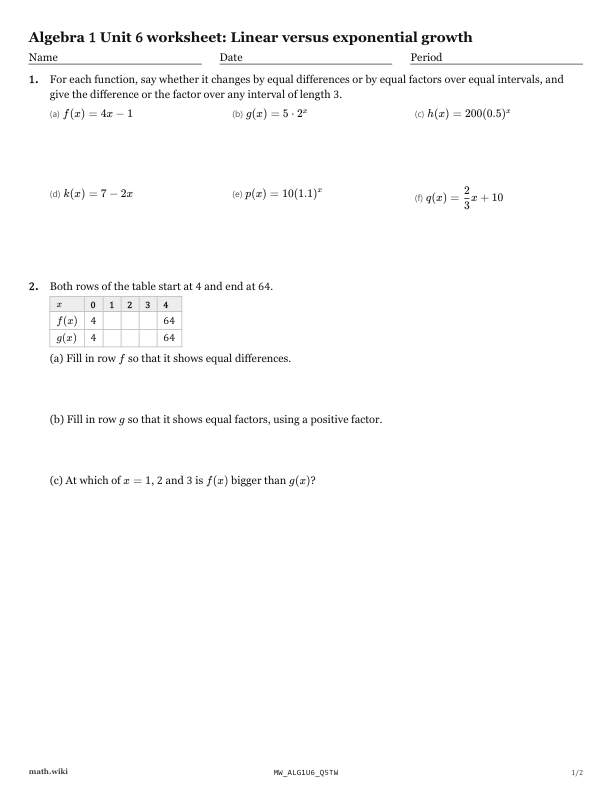
- Say whether each function has equal differences or equal factors, and give the value.f(x) = 4x - 1g(x) = 5 \cdot 2^xh(x) = 200(0.5)^xk(x) = 7 - 2xp(x) = 10(1.1)^x
- Fill in two table rows that start at 4 and end at 64: one linear and one exponential.
- Write rules for a linear and an exponential function that share two values and compare them.
- Two cars lose value in different ways: compare losing a fixed amount with a percent each year.
- Compare a slowly rising linear function with a decaying exponential and find when one overtakes.
- Find the ratios of consecutive outputs of a linear function and explain what they show.
Teach it first
The free lesson teaches it with worked examples and practice problems.
Linear versus exponential growth: the lesson ›More Chapter 6 worksheets: Exponential functions and choosing a model
- 6.1Growth and decay factors
- 6.2What an asymptote is
- 6.3Graphs of exponential functions
- 6.4Writing an exponential function from a table or graph
- 6.5Linear versus exponential growth
- 6.6Choosing a function family for data
- 6.7Interpreting the numbers in a model
- 6.8Building a model from a description
- 6.9Where a model holds: domain, interpolation and extrapolation
- 6.10Multiplying and dividing powers with the same base
- 6.11Powers of powers, products and quotients
- 6.12Zero and negative exponents