Page 1 of 2
Download
Get this sheet
SubscriptionOpen any sheet in any course, up to 40 a month, keys included. Or $40 month to month.
$25/mo, billed yearly
SubscribeTry one first: a free Chapter 1 worksheet (PDF, no sign-in).
What's on the worksheet
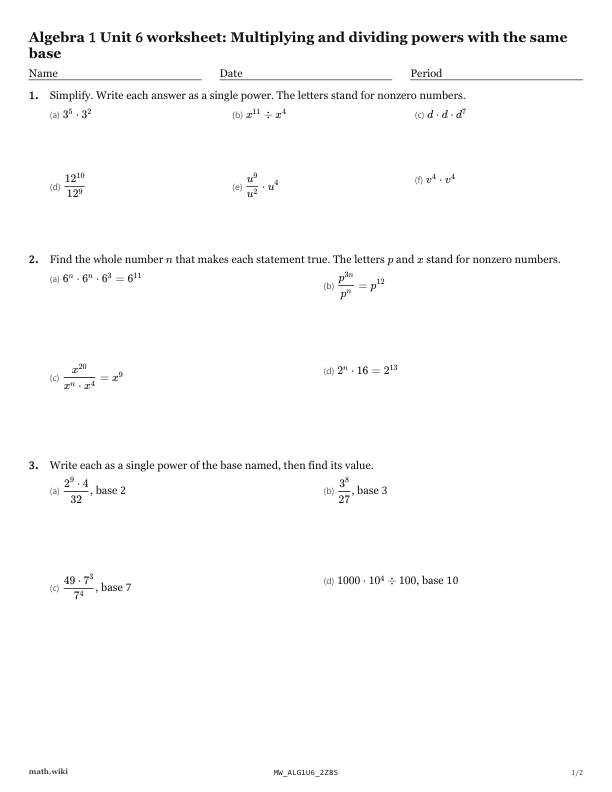
- Simplify each product or quotient as a single power.3^{5} \cdot 3^{2}x^{11} \div x^{4}d \cdot d \cdot d^{7}\dfrac{12^{10}}{12^{9}}\dfrac{u^{9}}{u^{2}} \cdot u^{4}
- Find the whole number exponent that makes each statement true.6^{n} \cdot 6^{n} \cdot 6^{3} = 6^{11}\dfrac{p^{3n}}{p^{n}} = p^{12}\dfrac{x^{20}}{x^{n} \cdot x^{4}} = x^{9}2^{n} \cdot 16 = 2^{13}
- Write each expression as a single power of the named base and find its value.\dfrac{2^{9} \cdot 4}{32}, base 2\dfrac{3^{8}}{27}, base 3\dfrac{49 \cdot 7^{3}}{7^{4}}, base 71000 \cdot 10^{4} \div 100, base 10
- Simplify expressions with exponents that contain n to a single power.\dfrac{a^{5n}}{a^{2n}}c^{n} \cdot c^{n} \cdot c^{n+1}\dfrac{b^{2n+5}}{b^{n+1}}\dfrac{y^{4n} \cdot y^{n}}{y^{3n}}
- Decide whether each statement is true or false and correct the false ones.5^{3} \cdot 5^{6} = 5^{18}\dfrac{x^{12}}{x^{3}} = x^{4}2^{4} \cdot 2^{4} = 2^{8}3^{2} + 3^{2} = 3^{4}2^{5} \cdot 3^{2} = 6^{7}
- Warehouse problem: count the pencils using powers of 3.
- Explain why two equal powers add to a power with exponent one higher, then use it.
Teach it first
The free lesson teaches it with worked examples and practice problems.
Multiplying and dividing powers with the same base: the lesson ›More Chapter 6 worksheets: Exponential functions and choosing a model
- 6.1Growth and decay factors
- 6.2What an asymptote is
- 6.3Graphs of exponential functions
- 6.4Writing an exponential function from a table or graph
- 6.5Linear versus exponential growth
- 6.6Choosing a function family for data
- 6.7Interpreting the numbers in a model
- 6.8Building a model from a description
- 6.9Where a model holds: domain, interpolation and extrapolation
- 6.10Multiplying and dividing powers with the same base
- 6.11Powers of powers, products and quotients
- 6.12Zero and negative exponents